
Cats sleep for roughly 70% of their lives, yet in their waking hours they manage to be funny, eerie, and biologically bizarre all at once. Some facts make you laugh, like how a cat’s purr can register at a frequency linked to bone healing, while others, like a black cat’s mixed-up history across cultures, feel almost like folklore. This guide pulls together the most fun, weird, creepy, and scientifically verified cat facts in one place, organized so you can jump straight to what you’re curious about: quirky behavior, eye anatomy, rare coat patterns, wild cats, or just trivia to share with your kids. If you enjoy this kind of deep dive, our collection of weird animal facts covers plenty of other species with the same “too strange to be true” appeal.
Fun And Funny Cat Facts
They are natural comedians, and a lot of their funniest behavior comes down to instincts that look absurd to us but make perfect sense to them. From sudden zoomies to a fascination with empty boxes, these are the cat facts that make people laugh out loud and immediately want to share them.

Hilarious Things Cats Do
Cats will almost always choose the empty box over the expensive toy sitting right next to it, and there’s real biology behind the joke. Boxes mimic tight, enclosed spaces that make them feel safe and hidden from predators, which is also why a cat can squeeze into a container that looks far too small for its body. This same instinct explains the late-night “zoomies,” when a cat suddenly sprints through the house at full speed. It’s a quick release of pent-up energy that wild cats would normally burn off hunting. Even a cat’s tendency to stare blankly at a wall or a corner often has a simple explanation: dust particles, shifting light, or a sound just outside human hearing range are usually enough to set off five straight minutes of intense focus.
Fun Facts Kids Will Love
Kids tend to love the cat facts that sound almost too strange to be true, and one of the best examples is that a cat’s nose print is impressive, just like a human fingerprint. They also have a special “righting reflex” that lets most of them land on their feet when they fall, thanks to an extremely flexible spine and a built-in sense of balance. Though it’s not a guarantee, it’s never something to test on purpose. Another favorite: They can make over 100 different sounds, far more than dogs, which is part of why a single cat can have such a distinct “vocabulary” of meows, chirps, and trills that its owner learns to recognize. For more animal trivia kids tend to love, our fun facts about animals roundup is a good next stop.
Fascinating And Unusual Cat Facts
Some of the most fascinating cat facts come straight from biology, quirks of anatomy and physiology that sound made up but are fully documented by veterinary science. These are the unusual cat facts that make you look at your own cat a little differently.

Surprising Biology Facts
A cat’s body runs on a different set of rules than most mammals, starting with its skeleton: They have 230 bones, compared to the 206 in an adult human, and around 10% of those are in the tail alone, which is why tail injuries can affect a cat’s balance so dramatically. Their hearing is just as specialized: They can detect sounds up to 64,000 Hz, far beyond the 20,000 Hz ceiling for humans and even above the range most dogs can hear, which helps explain why a cat reacts to a noise long before its owner notices anything. Cats are also one of the few mammals that can’t taste sweetness at all, missing the specific taste receptor gene that detects sugar, so that craving for ice cream or cake is a purely human (or dog) experience.
Facts That Sound Fake (But Aren’t)
A cat’s purr falls within a frequency range generally between 25 and 150 Hz, overlapping with frequencies shown to support bone density and tissue healing, which is one reason some researchers describe purring as a possible low-grade self-repair mechanism, not just a sign of contentment. Cats also sweat almost exclusively through their paw pads, since they have very few sweat glands elsewhere on their body, relying instead on grooming and panting to manage their temperature. Perhaps strangest of all: a cat’s whiskers are roughly as wide as its body, acting like built-in measuring tools that let it judge in an instant whether a gap or opening is safe to fit through. Unusual sensory adaptations aren’t unique to them either; the Hawaii state fish has its own set of surprising traits worth a look.
Creepy And Unsettling Cat Facts
Not every cat fact is cute; some are genuinely unsettling once you know the biology or history behind them. These creepy cat facts blend real science with centuries of superstition, and the line between the two isn’t always where you’d expect.

Eerie Cat Behaviors, Explained
A cat staring at you in total silence, unmoving, for minutes at a time can feel oddly menacing. Still, it’s usually just intense focus. They process visual information differently from humans and often freeze while tracking subtle movement or sound. More unsettling is a behavior some cat owners report: cats appear able to sense illness or impending death in humans, most famously documented in a 2007 case of a nursing home cat named Oscar, who reportedly positioned himself beside dying patients hours before they passed, a pattern hospice staff tracked across dozens of cases. Cats’ eyes glowing in the dark add to the eerie effect; the tapetum lucidum causes it, a nostalgic layer behind the retina that bounces light back through the eye, providing them with sharper night vision and that unmistakable, glowing stare when caught in headlights or a camera flash. If unsettling animal trivia is your thing, facts about snakes deliver a similar mix of fascinating and unnerving.
Folklore vs. Science
Black cats have been associated with bad luck across much of Western folklore since the medieval period, when they were linked to witchcraft and superstition, yet in parts of Britain and Japan, a black cat crossing your path is thought to bring good luck. There’s no biological difference behind any of it, only cultural history. They were also worshipped as sacred animals in ancient Egypt, where killing one, even accidentally, could carry the death penalty, a stark contrast to the witch-hunt-era Europe that saw cats killed by the thousands as suspected demonic familiars. Modern science has settled at least one old wives’ tale: they do not actually steal a baby’s breath while sleeping, a myth from centuries ago that likely originated from cats simply seeking out warm spaces to nap, including a crib.
Black Cat Facts And Folklore
Black cats carry more cultural baggage than any other coat color, with reputations that swing from cursed to lucky depending entirely on where in the world you ask. These black cat facts go beyond the broad “good luck vs. bad luck” split to examine the specific traditions, biology, and trivia associated with this one color.

History and Superstitions
In the United States and much of continental Europe, a black cat crossing your path is still widely seen as a bad omen. This superstition hardened during the European witch trials of the 15th to 17th centuries, when black cats were frequently accused of being witches’ familiars and killed alongside their owners. Sailors, however, broke from this pattern entirely. In British and Irish maritime tradition, a black cat on board a ship was considered a guarantee of safe passage, and fishermen’s wives sometimes kept one at home specifically to protect their husbands at sea. Germany splits the difference by direction: a black cat crossing left to right is bad luck, but right to left is good luck, showing how the same animal can carry opposite meanings even within a single region’s folklore.
Fun Facts Specific to Black Cats
Solid black coats in cats are caused by a predominant gene that delivers high levels of eumelanin, the same pigment responsible for dark hair and skin in humans. Because the gene is dominant, black cats are among the most common coat colors worldwide. Despite that abundance, data from U.S. shelters consistently show that black cats are adopted less often and wait longer for homes than cats of other colors, a trend animal welfare groups have linked partly to lingering superstition and partly to black fur appearing less distinct in adoption photos. On a lighter note, black cats can develop a condition where their coat looks “rusty” or faintly red-brown in strong sunlight, a real, harmless effect of sun exposure breaking down pigment in the fur, not a sign of poor health.
Cat Behavior Explained
Most cat behavior that looks random or even rude to humans is actually a holdover from wild instincts that helped them survive as both predator and prey. Once you understand the logic behind it, things like kneading, head-butting, and sudden tail flicks stop being mysterious and start making a lot of sense.

Why Cats Do What They Do
Kneading that rhythmic pawing motion them do on blankets, laps, or soft surfaces traces back to kittenhood, when kittens knead their mother’s belly to stimulate milk flow, and many cats simply never outgrow the behavior because it’s tied to comfort and contentment. Head-butting, technically called “bunting,” serves a more practical purpose: they have scent glands concentrated around their cheeks and forehead, so bunting against a person or object is a way of marking territory and claiming ownership, which is also why a cat headbutting you is considered a sign of trust and affection. Scratching furniture isn’t about destruction either; it’s a combination of claw maintenance, scent-marking through glands in the paws, and a way to stretch muscles, which is why redirecting the behavior to a scratching post works far better than trying to stop it outright.
Body Language Decoded
A cat’s tail is one of the clearest windows into its mood: a tail held straight up usually signals confidence and friendliness. At the same time, rapid side-to-side flicking is a warning sign of irritation or overstimulation, often appearing right before a swat or a quick retreat. Slow blinking is the opposite of a warning: when a cat glances at you and slowly shuts its eyes, it’s often called a “cat kiss,” and behaviorists widely interpret it as a sign of trust. Humans who slow-blink back can sometimes get the same gesture in return. Ears are just as telling, and a 2022 behavioral study tracking domestic cats found that ear position alone could predict stress responses with notable accuracy, with flattened or “airplane” ears reliably signaling fear or aggression well before any other visible cue appeared. Body language is just as revealing in other animals. Our fun facts about horses piece breaks down how horses communicate mood in similar ways.
Cat Eyes And Eyesight Facts
Cat eyes are built for hunting in near-darkness, which is why their vision differs so significantly from human vision in almost every measurable way. These cat eye facts explain why a cat can spot a moving toy across a dark room but might walk right past one sitting still in broad daylight.

How Cats See the World
They see roughly six to eight times better than humans in low light, thanks largely to the tapetum lucidum, a mirror-like layer behind the retina that reflects light through the eye for a second pass, giving photoreceptors extra opportunity to catch what little light is available. That same adaptation is responsible for the eerie glow seen in cat eyes under a flashlight or camera flash. The tradeoff is that cats are far less sensitive to fine detail and color than humans; their world leans toward blues, yellows, and grays, with little capacity to differentiate reds and greens, which is closer to a mild form of red-green color blindness in humans. Movement, not detail, is what a cat’s vision is optimized to catch. A wide field of view near 200 degrees and a high density of motion-detecting rod cells make even the slightest twitch of a toy or a bug instantly noticeable, even if the object itself is barely visible when still. The octopus takes visual adaptation even further, with an entirely different approach to detecting light and movement underwater.
Eye Color And Vision Science
Eye color in them comes from melanin concentration in the iris and has no connection to a cat’s ability to see, despite some lingering myths suggesting otherwise. The one documented exception involves white cats with blue eyes, which have a significantly higher rate of congenital deafness. A 2018 review of feline genetics studies found that blue-eyed white cats have a 65–85% chance of deafness in one or both ears, linked to the same gene responsible for both the lack of pigment and inner-ear development. Kittens are born with blue eyes, yet their eventual adult color, since melanin production in the iris doesn’t fully kick in until around 6 to 8 weeks of age. That is why a kitten’s “true” eye color often isn’t visible until closer to three months old.
Rare And Unique Coat-Pattern Cats
Coat pattern in them is one of the most genetically interesting traits in the animal kingdom, since some of the rarest-looking patterns come from straightforward, well-understood genetics rather than anything mysterious. These cat facts cover the patterns and breeds people search for most, from tortoiseshell coloring to the pointed coats of Himalayan- and Siamese-descended cats.

Tortoiseshell And Bicolor Cats
Tortoiseshell coloring, the mottled mix of black, orange, and sometimes cream patches, is tied directly to the X chromosome, since the gene controlling orange versus black fur sits on that chromosome, and a cat needs two different versions to display both colors at once. Because male cats typically have only one X chromosome, tortoiseshell cats are almost always female, and the rare tortoiseshell male that does occur typically carries an extra X chromosome, a genetic condition that usually also makes him sterile. Bicolor cats follow a separate genetic rule entirely, driven by a “white spotting” gene that blocks pigment from reaching certain areas of the coat, which is why bicolor patterns can range from a small white patch on the chest to nearly all-white cats with just a few colored markings remaining. Color patterns this distinctive aren’t limited to cats; the butterfly’s wing patterns follow their own remarkable genetic logic.
Himalayan, Snowshoe and Tonkinese Breeds
Himalayan cats get both their name and their striking blue eyes and pointed coloring from Siamese ancestry, crossed with the long, plush coat of Persian cats, resulting in a species that connects the temperament of one parent breed with the appearance of the other. Snowshoe cats carry a similar pointed pattern but add white “boots” on their paws, caused by the same white spotting gene seen in bicolor cats layered on top of Siamese-style point coloring, which is why no two Snowshoe cats have identical markings. Tonkinese cats sit genetically between Siamese and Burmese ancestry, producing a coat color called “mink” that’s darker and less contrasted than a classic Siamese point, a deliberate result of decades of selective breeding aimed at blending the two breeds’ best traits rather than a naturally occurring mutation.
Wild Cats And Cat Habitats
Domestic cats share most of their instincts with their wild relatives. Still, the habitats and survival pressures facing wild cats are a different story entirely, shaped by territory, prey availability, and in many cases, serious conservation threats. These cat facts cover how wild cats actually live in the wild, alongside the very different reality facing cats waiting in animal shelters.
How Wild Cats Live
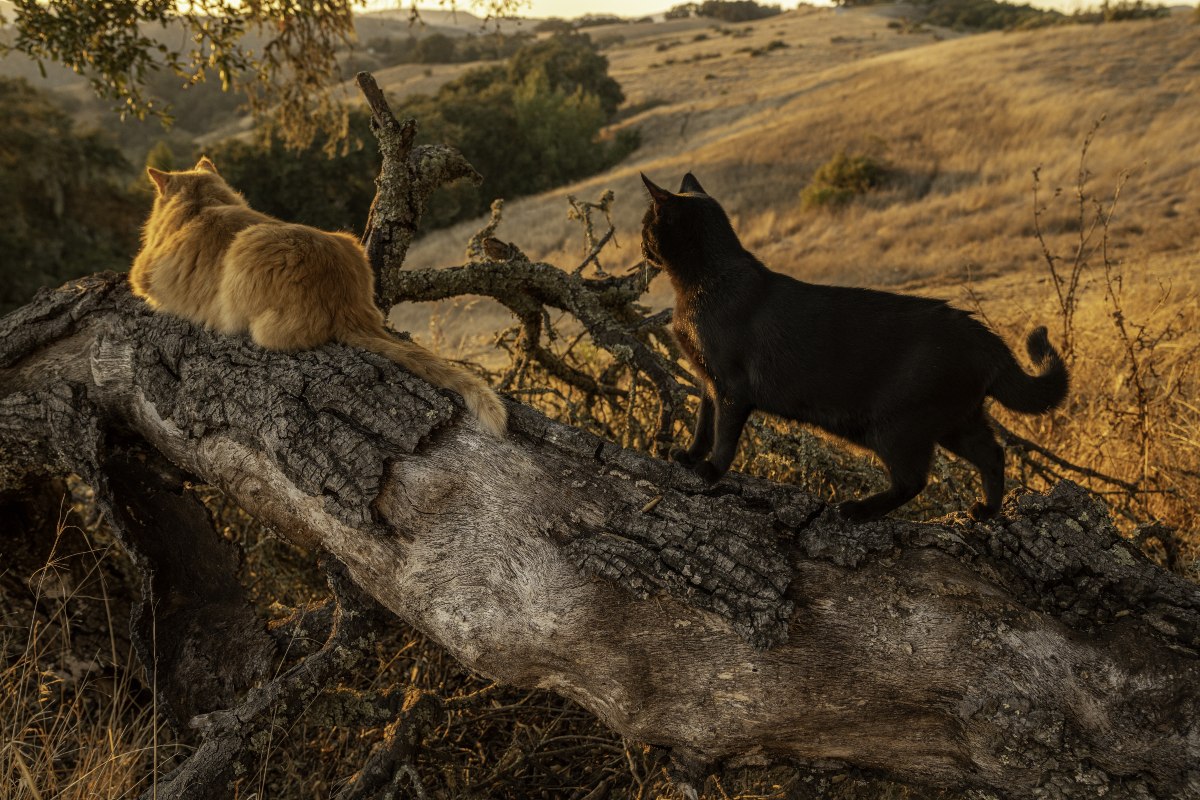
Wild cat species are found on every continent except Antarctica and Australia, ranging from the snow leopard’s high-altitude territory in the Himalayas to the sand cat’s burrows in the Sahara, each adapted through generations to extremely specific climates and prey. Most wild cats are solitary and territorial, marking and patrolling ranges that can stretch from a few square miles for smaller species to well over 100 square miles for them like the cougar, with size driven largely by how much prey is available in a given area. Conservation status varies sharply across species according to the IUCN Red List. Several wild cat species, including the Iberian lynx and the Amur leopard, are classified as endangered, with populations in the low hundreds, largely due to habitat loss and human encroachment rather than natural decline. Domesticated farm animals have their own distinct habitat needs, too. See our fun facts about dual cattle for a look at a very different kind of animal husbandry.
Shelter Cats Facts Worth Knowing
Millions of cats are adopted in the U.S. each year, and according to the ASPCA, roughly 3.2 million are taken in annually, with adoption rates having improved significantly over the past two decades thanks to expanded foster networks and no-kill initiatives. Shelter cats often arrive with behavior labeled as “shy” or “unadoptable.” Still, veterinary behaviorists note that much of this is simply stress from the shelter environment itself. Many cats show a complete personality shift within the first few weeks in a calm home. Senior cats and black cats consistently have the longest average shelter stays, a pattern that shelters have addressed with targeted adoption events, since neither trait affects a cat’s health, temperament, or suitability as a pet.
Cat Facts for Kids
Kids love cat facts that are easy to picture and fun to repeat, especially the ones that sound almost unbelievable but turn out to be completely true. This section keeps things simple and visual, making it a good fit for young readers, classroom trivia, or school projects that need a few solid, accurate facts.

Easy, Kid-Friendly Trivia
A cat’s whiskers aren’t just for show; they help a cat sense the size of spaces and even feel changes in air movement, almost like a built-in radar system. Kittens are born incapable of seeinging hearingearing at all, opening their eyes for the first time at a7 sev10to ten days old, which is part of why newborn kittens rely so heavily on touch and smell to find their mother. They also spend an enormous part of their lives sleeping, with most adult cats resting for about 12 to 16 hours a day, far more than the typical 8 hours a person sleeps each night.
Fun Facts for School Projects
For a science or animal-report project, one strong fact to include is that a group of cats is called a “clowder,” a term that often gets a laugh and works well as an opening hook. Another reliable fact: they have a third eyelid, called the nictitating membrane, which usually stays hidden in the corner of the eye but can become visible when a cat is sick or unusually tired, making it a useful real-world health fact as well as trivia. Cats also can’t move their jaw sideways the way humans can, since their jaw is built only for an up-and-down biting motion, which is one reason they tear and chew food differently than dogs or people do.
Conclusion
They earn their reputation as one of the most fascinating animals to share a home with, blending sharp survival instincts, unusual biology, and centuries of folklore into a single, endlessly curious creature. Whether it’s the science behind a purr’s healing frequency, the genetics that make tortoiseshell cats almost always female, or the simple fact that no two cats share a nose print, every layer of a cat’s behavior turns out to have a real explanation once you look closely. The next time a cat stares at an empty corner, headbutts your hand, or chooses a cardboard box over a brand-new bed, there’s a good chance one of these facts explains exactly why.
Frequently Asked Questions(FAQs)
What are some fun facts about cats?
One of the most fun facts about cats is that they can’t taste sweetness at all, since they lack the taste receptor gene that detects sugar, making a craving for dessert a purely human trait. They also make over 100 distinct vocal sounds, far more than dogs, and each cat develops its own recognizable “vocabulary” of meows and chirps over time.
Why do cats knead with their paws?
Cats knead because the motion traces back to kittenhood, when kneading a mother cat’s belly helped stimulate milk flow during nursing. Many adult cats never outgrow the behavior, using it instead to express comfort and contentment on soft surfaces like blankets or laps.
Do black cats really bring bad luck?
Black cats are only considered bad luck in some cultures, and the belief has no basis in fact; it’s purely a product of European folklore from the witch-hunt era. In countries like Japan and parts of Britain, a black cat scratching your path is actually considered a sign of good luck.
Can cats see in complete darkness?
They cannot see in complete darkness, but they need only a small fraction of the light humans require, thanks to a reflective layer behind the retina called the tapetum lucidum. This adaptation gives cats roughly six to eight times better low-light vision than humans, though some ambient light is still necessary.
How many bones does a cat have?
A cat has 230 bones, compared to 206 in an adult human, with nearly 10% of those in the tail alone. This extra flexibility is part of why cats have such a wide range of motion and a strong sense of balance.
Why do cats have whiskers?
Cats have whiskers to help them judge distances and detect changes in their surroundings, acting almost like a built-in measuring tool. A cat’s whiskers are approximately as wide as its body, which is why they’re so useful for instantly sensing whether a gap is safe to fit through.