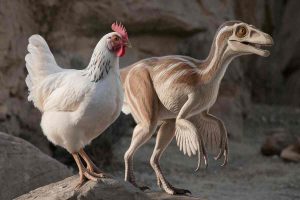
Birds are the only living descendants of dinosaurs, and that single fact hints at just how much strangeness and wonder is packed into this class of animals. From hummingbirds that beat their wings up to 80 times per second to Arctic terns that migrate roughly 44,000 miles a year, farther than any other animal on Earth, bird facts reveal a world that’s stranger, smarter, and more resilient than most people realise.
This guide brings together more than 150 bird facts in one place: how birds are built, how they behave, what makes specific species like robins, woodpeckers, and kiwis unique, where different birds live, which ones are endangered, and the small, surprising details that make birdwatching (or just casual curiosity) so rewarding.
Whether you’re a student, a teacher building a lesson plan, a new birdwatcher, or simply someone who searched “fun facts about birds” out of curiosity, everything below is organised so you can jump straight to what you’re looking for or read start to finish and come away knowing more about birds than most people ever will. And if birds aren’t the only animal group you’re curious about, our handbook to rabbit facts covers plenty of other fascinating creatures too.
What Makes Birds So Fascinating? (Bird Facts Overview)
Birds fascinate people because they’re living proof that evolution can turn a fearsome predator into something that fits in the palm of your hand. Every one of the roughly 10,000 to 11,000 known bird species alive today descended from theropod dinosaurs, which means the sparrow at your window and the Tyrannosaurus rex share a family tree. That connection alone explains why birds feel both familiar and slightly otherworldly; they’re dinosaurs that learned to sing.
What is a bird, exactly?
A bird is a warm-blooded vertebrate defined by three traits no other animal group shares in combination: feathers, a beak with no teeth, and the ability to lay hard-shelled eggs. Not every bird can fly; penguins, ostriches, and kiwis can’t, but every single bird species has feathers, which biologists consider the one truly universal marker of what makes an animal a bird rather than a reptile, mammal, or something else entirely. If you’ve ever wondered why birds are classified separately from mammals despite both being warm-blooded, our guide on are birds mammals breaks down that distinction in detail.
Key traits that define every bird species
Beyond feathers, birds share a handful of traits that set them apart from every other class of animal. They have hollow, lightweight bones that reduce body weight without sacrificing strength, a four-chambered heart that supports the high metabolism flight demands, and a respiratory system built around air sacs rather than simple lungs, allowing them to extract oxygen far more efficiently than mammals do. Most species also share strong parental instincts, with the majority of birds caring for their young until they can feed and fly independently, a level of investment that’s rare across the rest of the animal kingdom.
Fun and Amazing Bird Facts You Probably Didn’t Know
Some of the most fascinating bird facts aren’t about rare or exotic species; they’re about ordinary backyard birds doing extraordinary things. A crow, for instance, can recognise individual human faces and hold onto that memory for years, even warning other crows about people it considers threats. Facts like these are why “fun facts about birds” remains one of the most searched bird-related topics online: birds are constantly doing things that sound too strange to be true, yet are fully documented by researchers.
Weird bird behaviours that will surprise you
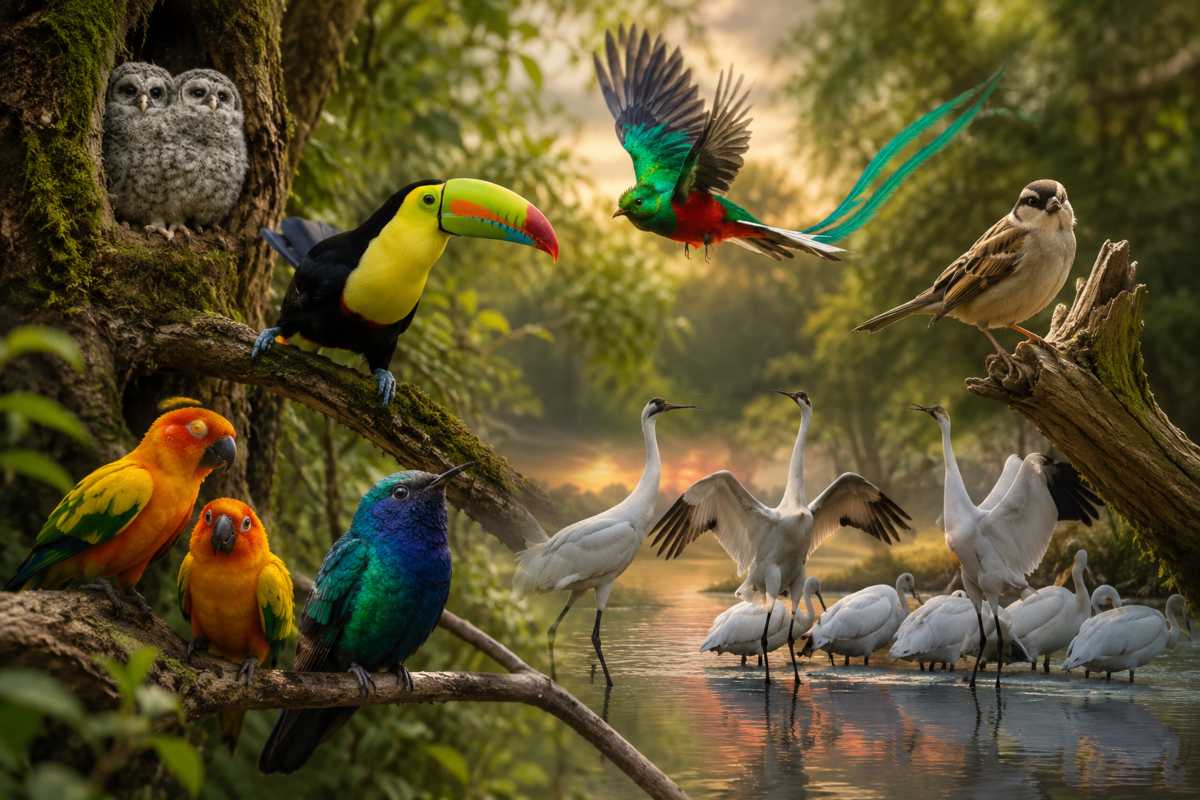
Some bird behaviours sound more like science fiction than biology. Male bowerbirds build elaborate, decorated structures called bowers, arranging berries, shells, and even bottle caps by colour purely to impress females, with no nesting function at all. Hoatzins, a South American bird, have chicks born with claws on their wings that let them climb back into trees if they fall, a trait that disappears as they mature. Woodpeckers hammer their beaks into trees up to 12,000 times a day without giving themselves brain damage, thanks to a spongy skull structure that absorbs shock like a built-in helmet.
And owls can rotate their heads up to 270 degrees because they have twice as many neck vertebrae as humans, compensating for eyes that are fixed in place and can’t move within their sockets, a trait worth exploring further in our piece on how long do owls live.
Funny and quirky bird facts
Not every bird fact is about survival; some are just plain funny. Penguins propose to their mates with a pebble, presenting a smooth stone as a kind of engagement gift before building a nest together. Flamingos can only eat with their heads upside down, since their beaks are specially shaped to filter food while inverted in the water; find out more about their unusual physiology in our guide on can flamingos fly.
Puffins are sometimes called “clowns of the sea” for their brightly coloured beaks and waddling walk, and kakapos, flightless parrots from New Zealand, are famous for freezing completely still when startled, apparently convinced that not moving makes them invisible. Roosters have their own set of quirky behaviours too, and our article on why do roosters crow explains the surprising science behind their morning wake-up calls.
100+ random bird facts (quick-hit list)
Here’s a fast-reading collection of bird facts spanning size, speed, intelligence, and pure oddity:
- The bee hummingbird, the smallest bird on Earth, weighs less than a dime.
- Ostriches lay the largest eggs of any living bird, sometimes over 5 pounds each.
- A peregrine falcon can dive at speeds over 240 mph, making it the fastest animal on the planet.
- Albatrosses can glide for hours without a single wingbeat, using ocean wind currents.
- Some parrots can live over 80 years in captivity.
- Chickens are the closest living relatives of the Tyrannosaurus rex.
- A group of crows is called a “murder,” and these birds are remarkably long-lived for their size. See how long do crows live?
- Kiwis lay eggs that can weigh up to 20% of their body weight.
- Emperor penguins can hold their breath underwater for over 20 minutes.
- Hummingbirds are the only birds that can fly backwards.
- Barn owls can locate prey in complete darkness using hearing alone.
- Arctic terns migrate roughly 44,000 miles round-trip each year, the longest migration of any animal.
- A robin’s red breast is actually orange, but the colour got its name before English had a separate word for orange.
- Woodpeckers have tongues that wrap around the inside of their skulls for extra length.
- Vultures have stomach acid strong enough to dissolve bone.
- Some songbirds can sing two different notes at once using two independent voice boxes.
- Magpies are one of the few animals that can recognise themselves in a mirror.
- A hummingbird’s heart can beat over 1,200 times per minute during flight.
- Cassowaries are considered one of the most dangerous birds due to their sharp claws.
- Bald eagles aren’t actually bald; their name comes from an old word meaning “white-headed.”
- Pigeons can be trained to recognise human faces and even distinguish paintings by different artists.
- The wandering albatross has the largest wingspan of any living bird, over 11 feet.
- Swifts can stay airborne for months at a time, even sleeping mid-flight.
- Toucans use their oversized beaks to regulate body temperature, not just to reach fruit.
- Some ducks can sleep with one half of their brain awake to watch for predators, and bees have their own surprising honey-related habits worth checking in do bees eat honey?
- Sparrows were the first birds domesticated for scientific study of genetics.
These facts only scratch the surface of what makes birds one of the most studied and beloved animal groups on Earth, but they’re a fast way to see why bird facts consistently capture public curiosity across every age group.
How Birds Live: Behaviour, Anatomy and Daily Life
A bird’s day is structured almost entirely around energy: finding food, avoiding predators, and conserving enough strength to survive the night. Because most birds have extremely fast metabolisms, a chickadee, for example, needs to eat roughly 35% of its body weight in food every day just to survive winter temperatures. Daily life for a bird is a constant balancing act between activity and rest.

What do birds do all day?
Most birds spend the majority of daylight hours foraging for food, since their high metabolic rate means they can’t store large energy reserves the way mammals do. Early morning is typically the most active period, which is why dawn choruses of birdsong are so loud and layered; birds are simultaneously feeding, defending territory, and signalling to mates. Midday is often spent resting, preening feathers to keep them clean and aerodynamic, or seeking shade to regulate body temperature.
As light fades, birds shift toward finding a safe roosting spot, since most species have poor night vision and are vulnerable to predators after dark. This daily rhythm repeats with small variations depending on species, season, and whether a bird is raising young.
Bird anatomy and body structure explained.
A bird’s body is engineered almost entirely around the demands of flight, even in species that no longer fly. Bones are hollow and reinforced with internal struts, making the skeleton light enough for lift-off while remaining strong enough to withstand the stress of flapping and landing. Feathers serve multiple functions beyond flight, including insulation, waterproofing, and camouflage, and are replaced periodically through a process called moulting.
Birds also lack teeth, relying instead on a muscular organ called the gizzard to grind food, often with the help of small stones they swallow intentionally. Their respiratory system is unique among vertebrates, using a network of air sacs that keeps oxygen-rich air flowing through the lungs in one continuous direction rather than the in-and-out breathing pattern mammals use a design that makes sustained, high-altitude flight possible.
How birds communicate, migrate and nest.
Birds communicate primarily through vocalisations and visual displays, using song to attract mates, defend territory, and warn of predators, with many species capable of producing dozens of distinct calls, each carrying a different meaning. Migration is driven by the search for food and favourable breeding conditions, and birds navigate these journeys using a combination of the sun’s position, star patterns, and an internal sense of Earth’s magnetic field, a sensory ability humans don’t possess at all. Nesting behaviour varies enormously across species, from simple scraped-out ground nests to elaborately woven structures built entirely without tools. Still, nearly all nesting birds share the same underlying goal: creating a protected space where eggs can incubate safely until hatching.
Facts About Popular Bird Species
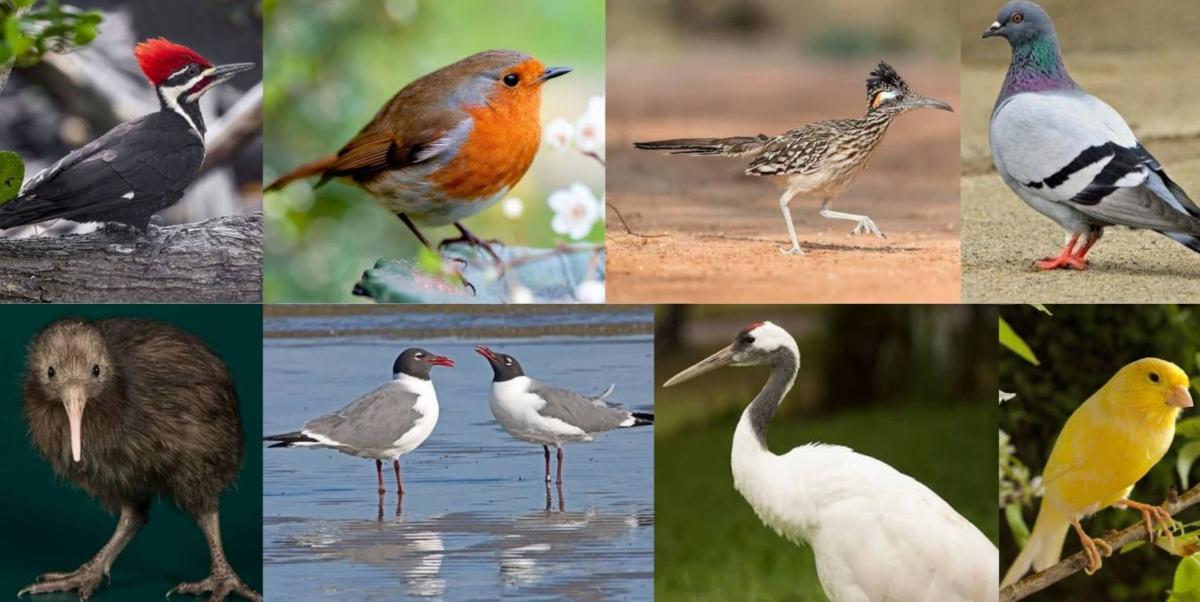
Some birds are so common that people overlook how remarkable they actually are. Robins signal the start of spring, woodpeckers hammer through wood at bone-jarring speeds, and pigeons navigate cities using a sense humans don’t even have; each species below has its own set of traits that make it worth a closer look.
Robin facts (American robin)
The American robin is one of the most recognisable birds in North America, identified instantly by its orange-red breast, even though the colour is technically closer to orange than true red; the bird was simply named before English had a separate word to describe it. Robins are early risers and among the first birds heard singing at dawn, and they’re famous for being one of the clearest signs of spring, since large numbers migrate north as temperatures warm. A single robin can eat up to 14 feet of earthworms in a day, and despite popular belief, robins don’t actually leave an area entirely in winter; many simply shift from lawns to forests in search of berries.
Woodpecker facts
Woodpeckers are built to survive an impact that would concuss almost any other animal, striking wood up to 12,000 times a day at forces that would cause severe brain trauma in humans. Their skulls contain a spongy, shock-absorbing bone structure, and their brains are packed tightly enough to prevent the kind of movement that causes injury on impact. Woodpeckers also have unusually long, barbed tongues that wrap around the inside of the skull when not in use, allowing them to extend deep into tree bark to extract insects. Their drumming serves a dual purpose: it’s used both to find food and to communicate territory to other woodpeckers, functioning almost like birdsong.
Crane facts
Cranes are among the tallest flying birds in the world, with some species standing over 5 feet tall, and they’re known for elaborate mating dances that involve jumping, bowing, and synchronised movement between pairs. Many crane species mate for life, often reuniting at the same nesting site year after year, and their loud, trumpeting calls can carry for miles across open wetlands due to a specially coiled windpipe that amplifies sound. Several crane species, including the whooping crane, are considered endangered, making conservation efforts a major focus of crane research worldwide.
Kiwi facts
Kiwis are flightless birds native to New Zealand, and they’re unusual among birds for laying eggs that can weigh up to 20% of their body weight, proportionally the largest egg-to-body-size ratio of any bird species. Unlike most birds, kiwis have nostrils at the tip of their long beak rather than at the base, giving them an exceptional sense of smell they use to locate insects and worms underground. Kiwis are also nocturnal, which is rare among birds, and their feathers are closer in texture to hair than to typical plumage, helping them blend into New Zealand’s forest floor.
Canary facts
Canaries are small songbirds originally native to the Canary Islands, prized for centuries for their bright colouring and complex, melodic song. Wild canaries are typically a duller yellow-green, while the vivid yellow most people associate with the species developed through selective breeding in captivity. Canaries were historically used in coal mines to detect dangerous gases, since their fast metabolism and sensitive respiratory systems caused them to show signs of distress before humans would notice a leak. This practice gave rise to the phrase “canary in a coal mine.”
Gull and seagull facts
Despite the common name “seagull,” there’s no single species officially called a seagull; the term refers broadly to gulls, many of which live far from the ocean near lakes, rivers, and even parking lots. Gulls are highly intelligent and adaptable, capable of problem-solving behaviours like dropping shellfish onto hard surfaces to crack them open. They’re also opportunistic feeders, which is why they’re commonly seen scavenging in urban and coastal areas alike, and some species can live over 30 years in the wild, a fish-related detail worth pairing with our guide to the Hawaii state fish for more on marine life diversity.
Roadrunner facts
Roadrunners are ground-dwelling birds best known for their speed, capable of running up to 20 miles per hour to chase down prey rather than relying on flight. They primarily eat insects, lizards, and small snakes, including rattlesnakes, which they kill by repeatedly slamming them against the ground. You can learn more about the reptiles roadrunners hunt in our guide to facts about snakes. Roadrunners are technically capable of flight but rarely use it, preferring to sprint across open desert terrain, and their long tail acts as a rudder that helps them make sharp turns at high speed. Desert habitats are also home to other unusual creatures, including the camel spider, which roadrunners occasionally prey on as well.
Pigeon facts
Pigeons are far more capable than their reputation suggests, with documented abilities to recognise individual human faces, distinguish between paintings by different artists, and navigate home from distances of over 1,000 miles using a combination of magnetic sensing, sun position, and smell. Historically, pigeons were used to carry written messages during wartime, some credited with saving hundreds of lives by delivering critical information under fire. Their strong homing instinct comes from an internal compass sensitive to Earth’s magnetic field, a navigational ability still not fully understood by scientists today.
Birds by Region and Habitat
Where a bird lives shapes nearly everything about it: its diet, its migration pattern, even the shape of its beak, which is why bird species vary so dramatically from one region to the next. A bird native to the Arctic tundra and a bird native to a tropical rainforest may share almost nothing in common except feathers and flight, because habitat drives adaptation more than almost any other factor in a bird’s life.
Native birds and where to find them
A native bird occurs naturally in a region without human introduction, having evolved there over thousands of years alongside the local climate, plants, and predators. Native birds are typically the best indicator of a healthy ecosystem, since their populations depend on specific food sources and nesting conditions that only intact habitats can provide. In North America alone, there are over 900 native bird species, ranging from backyard regulars like cardinals and blue jays to more elusive forest and wetland species that most people never see.
Finding native birds usually comes down to habitat: forests, wetlands, grasslands, and coastlines each support a distinct community of species, which is why birdwatchers often travel to specific ecosystems rather than expecting to see every bird in one place.
Northern birds vs eastern birds
Northern birds are generally adapted to cold, harsh conditions, favouring dense insulating feathers, shorter migration distances, and diets built around seeds, berries, and insects that remain available through colder months. Species like snowy owls and boreal chickadees are classic examples, and they often share their frigid habitat with other cold-adapted animals like the Arctic fox. Eastern birds, by contrast, tend to inhabit more temperate, forested regions with milder winters, supporting a wider diversity of species overall, including many songbirds that migrate seasonally rather than remaining year-round. The distinction isn’t a strict geographic line so much as a reflection of climate and habitat type, since some species range across both zones depending on season, food availability, and breeding needs.
Wild bird species and breeds around the world
Globally, there are an estimated 10,000 to 11,000 wild bird species, distributed across every continent including Antarctica, where species like the emperor penguin have adapted to conditions no other bird class could survive. Tropical regions near the equator hold the highest concentration of bird diversity on Earth, with countries like Colombia and Peru each home to well over 1,800 recorded species, more than the entire bird population of North America combined.
This diversity exists because tropical climates offer stable food sources and breeding conditions year-round, allowing far more specialised adaptations to develop than in regions with harsh seasonal shifts, which is part of why rainforest ecosystems remain such a critical focus for bird conservation worldwide. If unusual naming conventions interest you, our list of animals that start with X shows just how far animal diversity extends beyond birds alone.
Endangered Birds: Facts and Conservation Status
More than 1 in 8 bird species worldwide is currently threatened with extinction, according to BirdLife International, making habitat loss and climate change two of the most urgent issues in modern conservation. Endangered birds span every region and habitat type, from tropical rainforests to Arctic tundra, and their declining numbers often serve as an early warning sign of broader environmental damage.
Which bird species are most at risk?
The birds facing the greatest risk of extinction tend to share a few common vulnerabilities: small or shrinking habitat ranges, slow reproduction rates, and heavy dependence on a single food source or ecosystem. The California condor, for example, nearly went extinct in the 1980s when its wild population dropped to just 27 individuals, and it survives today only through an intensive captive breeding and reintroduction program.
The kakapo, a flightless parrot from New Zealand, remains critically endangered with fewer than 250 known individuals left, largely due to introduced predators like rats and stoats that the species never evolved defences against. Whooping cranes, several albatross species, and the Philippine eagle are also among the most at-risk birds globally, each threatened by a combination of habitat destruction, hunting, or accidental deaths from human infrastructure like power lines and fishing equipment.
Why bird conservation matters
Birds play a functional role in nearly every ecosystem they inhabit, from pollinating plants and dispersing seeds to controlling insect and rodent populations, which means their decline has ripple effects far beyond the species itself. Because birds are highly sensitive to environmental changes, shifts in temperature, food availability, or habitat quality often show up in bird populations before they’re detectable elsewhere. Conservationists frequently use bird data as an early indicator of ecosystem health. Protecting endangered bird species also protects the broader habitats they depend on, meaning conservation efforts aimed at a single species, like the whooping crane or California condor, often end up preserving wetlands, forests, and grasslands that countless other plants and animals rely on as well.
Bird Trivia and Quick-Reference Fact Sheets
Bird trivia works well as a quick way to test or build knowledge, and a good fact sheet format makes that information easy to scan, print, or use in a classroom setting. Below is a mix of quiz-style trivia and a condensed reference list designed for fast recall rather than deep reading.
Bird trivia quiz-style facts
Bird trivia tends to stick because it’s built around surprising contrasts with familiar animals doing unexpected things. Ask someone which bird lays the largest egg relative to its body size, and most won’t guess the kiwi, whose egg can weigh up to 20% of its total body mass. Ask which animal migrates farther than any other on Earth, and the answer isn’t a mammal or fish; it’s the Arctic tern, which travels roughly 44,000 miles round-trip between the Arctic and Antarctic each year.
Other strong trivia questions include which bird is the fastest animal alive (the peregrine falcon, diving at over 240 mph), which bird can fly backwards (the hummingbird), and which flightless bird has the strongest kick of any bird species (the ostrich, capable of killing a lion with a single strike). These kinds of questions work well for trivia nights, classroom review, or casual conversation because the answers are memorable precisely because they defy expectation.
Bird facts for kids and classrooms
Bird facts are especially effective as an educational tool because they combine biology, geography, and observable behaviour in ways kids can connect to real life. A bird seen outside a classroom window becomes a live example of concepts like migration, adaptation, or food chains. Simple, high-impact facts work best for younger students: birds are the only living animals with feathers, some birds like penguins can’t fly but are excellent swimmers, and a hummingbird’s heart can beat over 1,200 times per minute during flight.
For slightly older students, facts involving numbers and comparisons tend to land well, such as the Arctic tern’s 44,000-mile migration or the peregrine falcon’s 240 mph dive speed, since these give kids a tangible way to grasp scale and measurement through something as small as a bird.
Conclusion
Birds remain one of the most studied and beloved animal groups on Earth precisely because there’s always another surprising fact waiting to be discovered, whether it’s a hummingbird’s 1,200-beats-per-minute heart, a kiwi’s oversized egg, or a crow’s ability to remember a human face for years. From backyard robins to endangered California condors, bird facts connect biology, geography, and everyday observation in a way few other subjects can, making birds as rewarding to study as they are simple to enjoy from a window or a park bench.
Whatever brought you here curiosity, a classroom project, or a genuine interest in birdwatching the goal of this guide has been the same: to give you a single, reliable place to find accurate, well-organised bird facts without wading through scattered or unreliable sources. Birds have been evolving and adapting for over 150 million years, and there’s always more to learn about how they live, migrate, and survive. Come back to this guide anytime you need a quick fact, a classroom resource, or just a reminder of how remarkable the birds outside your window really are.
Frequently Asked Questions(FAQs)
What is the coolest bird fact?
One of the coolest bird facts is that the Arctic tern migrates roughly 44,000 miles round-trip every year, farther than any other animal on Earth. That means over its lifetime, a single tern can fly the equivalent distance of several trips to the moon and back.
What do birds do that humans don’t know about?
Birds can sense Earth’s magnetic field and use it to navigate during migration, a sense humans don’t possess at all. Many species also sleep with only half their brain at a time, staying alert to predators even while resting.
How many bird species exist in the world?
There are an estimated 10,000 to 11,000 known bird species living across every continent, including Antarctica. Tropical regions near the equator hold the highest concentration, with countries like Colombia recording over 1,800 species alone.