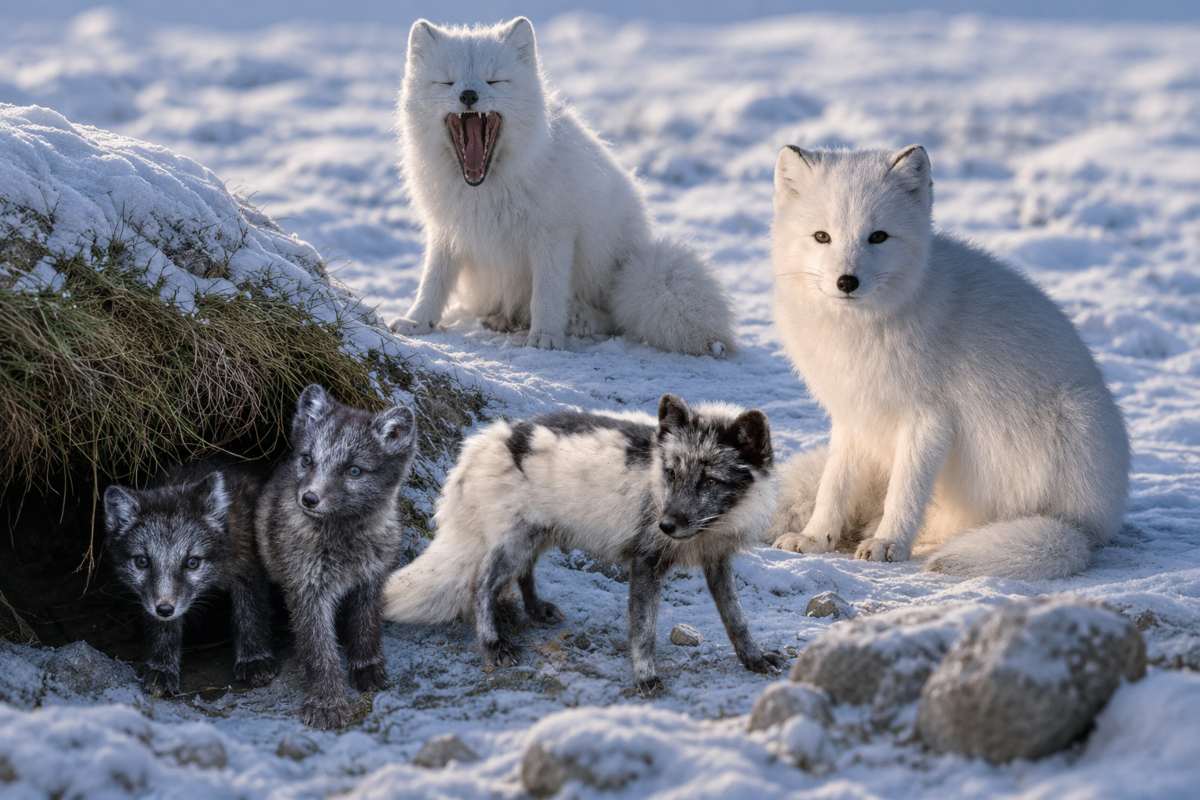
Arctic foxes (Vulpes lagopus) are small Arctic-dwelling canines best known for swapping a thick white winter coat for a brown-gray summer one, surviving temperatures as low as -58°F (-50°C) without shivering, and travelling hundreds of miles across sea ice in search of food. These arctic fox facts reveal one of the toughest small mammals on the planet: a fox built almost entirely for cold, with fur-covered paws that work like built-in snowshoes and a body shape engineered to lose almost no heat.
What makes the arctic fox especially remarkable is just how extreme its adaptations are. One tracked individual was recorded travelling over 2,700 miles (4,400 km) from Norway to Canada in just 76 days, one of the longest migrations ever documented for a land mammal its size. From its colour-changing camouflage to its surprising family life, here are 50+ facts that show why this pint-sized predator is an Arctic survival specialist.
Arctic Fox Facts at a Glance
The arctic fox is a small, cold-adapted canine native to the Arctic tundra, easily recognised by its seasonal coat change and compact, heat-conserving body. Below is a quick snapshot of what it is, where it lives, and how long it survives in the wild.

What Is an Arctic Fox?
The arctic fox (Vulpes lagopus) is a species of fox belonging to the Canidae family, closely related to red foxes but built specifically for extreme cold rather than temperate climates. It’s one of the smallest wild canids in the world, typically weighing between 6 and 10 pounds, roughly the size of a large cat, though its thick fur makes it look considerably bulkier. Its most defining trait is seasonal camouflage: a pure white coat in winter that blends into snow and ice, and a shorter, brown-to-gray coat in summer that matches the tundra’s rocky, thawed terrain.
Where Do Arctic Foxes Live?
Arctic foxes inhabit the circumpolar Arctic tundra, spanning Northern Canada, Alaska, Greenland, Iceland, Scandinavia, and Arctic Russia, and they’re also one of the few land mammals found on Arctic sea ice far from shore. They favour open, treeless tundra where they can dig extensive burrow systems, some of which are passed down and expanded across generations, growing to over 100 entrances in long-used dens. Unlike many Arctic species, they don’t hibernate; instead, they rely on fat reserves, dense fur, and opportunistic scavenging (including following polar bears to feed on leftover seal carcasses) to survive the winter active and above ground.
Arctic Fox Lifespan and Size
In the wild, arctic foxes typically live 3 to 6 years, though survival past age 3 or 4 is uncommon due to harsh conditions, predation, and food scarcity; in captivity, with steady food and no predators, they can live up to 14 years. Adults measure about 18 to 27 inches in body length, plus a bushy tail of roughly 12 inches used for both balance and warmth. Foxes often wrap their tails around their bodies like a blanket while sleeping to conserve heat.
Despite their small frame, they’re remarkably resilient: research has shown arctic foxes can withstand temperatures down to -58°F (-50°C) without increasing their metabolic rate, one of the most efficient cold-tolerance adaptations documented in any mammal. This trait puts them among the animals explored in our roundup of what is the strongest animal in the world by measures other than raw power.
Fun Facts About Arctic Foxes
Beyond their basic biology, Arctic foxes have a handful of quirky, genuinely surprising traits, from a coat that changes colour twice a year to hunting tricks that look more like a cat’s than a dog’s. Here are some of the most fun facts about arctic foxes, covering their camouflage and everyday behaviour.
Fun Facts About Their Fur and Camouflage
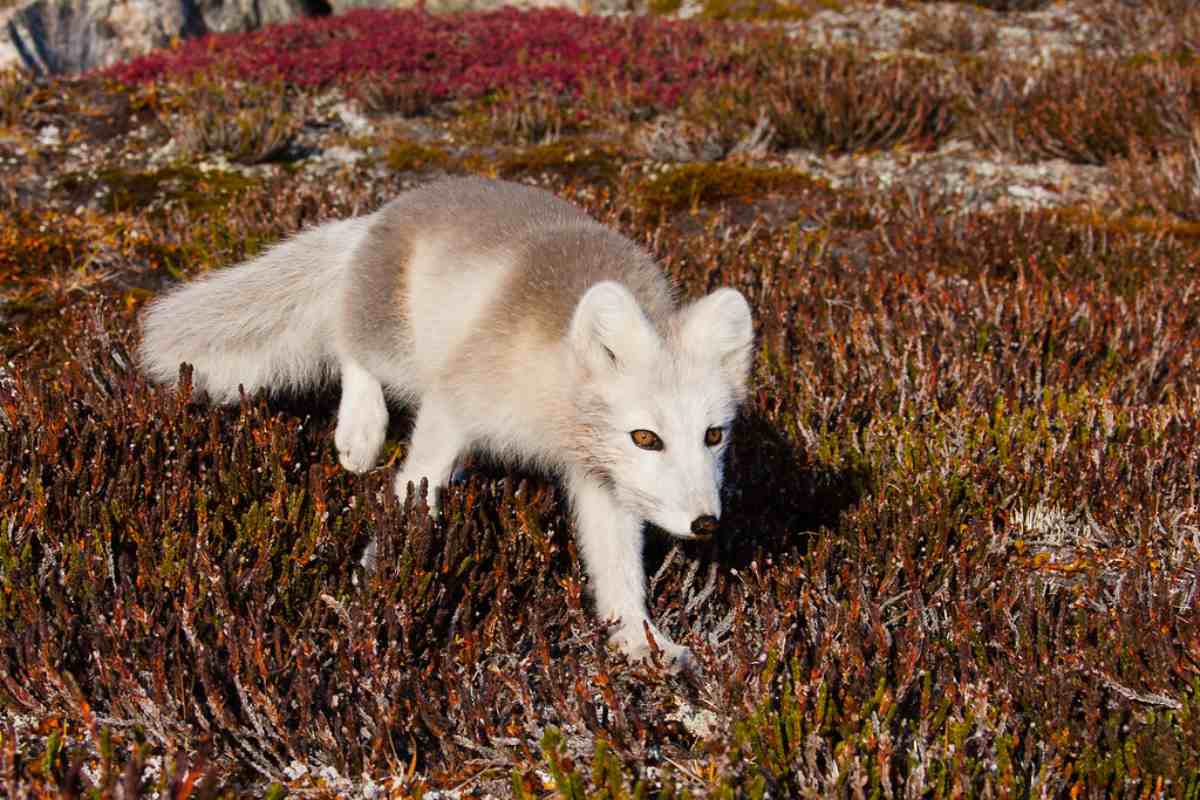
An arctic fox’s fur isn’t just thick; it’s the warmest of any mammal in the Arctic, with an insulating quality so effective that the fox’s body temperature stays stable even as the surrounding air drops far below freezing. The seasonal colour change happens gradually over several weeks in spring and fall, shifting from snow-white to a blue-grey or brown coat that matches thawed rock and tundra vegetation; a smaller population, known as “blue” arctic foxes, keeps a slate-blue-grey coat year-round instead of turning white, an adaptation more common in coastal areas with less snow cover.
Even their paws are built for the cold: dense fur grows on the pads of their feet, giving them extra grip and insulation on ice and earning them the nickname “polar fox” in some regions for their snow-shoe-like paws.
Fun Facts About Their Behaviour
Arctic foxes are known for a distinctive hunting technique called “mousing,” in which they stand still, listen for prey moving under snow, then leap high into the air and dive headfirst to break through the crust and catch it a behaviour nearly identical to the pouncing style used by red foxes and coyotes. They’re also impressively resourceful travellers: one satellite-tracked arctic fox crossed roughly 2,700 miles (4,400 km) of sea ice from Norway to Ellesmere Island in Canada in just 76 days, an extraordinary journey for an animal of its size.
Socially, arctic foxes are mostly monogamous, with breeding pairs often staying together for multiple seasons to raise litters that can include up to 14 pups, one of the largest litter sizes of any wild canid, and a stark contrast to the smaller family units typical of many fun facts about animals in temperate climates.
Interesting Facts About Arctic Foxes
The arctic fox’s ability to thrive in one of Earth’s harshest climates comes down to a set of highly specialised adaptations and an opportunistic, wide-ranging diet. Here are some of the most interesting facts about arctic foxes, from how their bodies handle extreme cold to what and how they actually eat.
Interesting Survival Adaptations
Arctic foxes are built to lose as little heat as possible: they have a compact, rounded body shape with short legs, a short muzzle, and small, rounded ears, all of which minimise surface area exposed to the cold, a physical strategy known as Allen’s rule. Their circulatory system reinforces this design through a counter-current heat exchange in their legs and paws, where warm arterial blood heats cold venous blood returning from the extremities, keeping their core temperature stable while their feet stay just above freezing.
This combination is so efficient that arctic foxes don’t start shivering or raising their metabolic rate until temperatures drop to around -94°F (-70°C), a threshold far lower than most mammals of similar size can tolerate.
Interesting Facts About Their Diet and Hunting
Arctic foxes are opportunistic omnivores, and their diet shifts dramatically with the seasons: in winter, they rely heavily on lemmings and other small rodents, while summer opens up options like birds, eggs, fish, berries, and carrion. Their population size is closely tied to lemming population cycles, which rise and fall roughly every 3 to 4 years.
During lemming booms, arctic fox litters grow larger, and survival rates climb, while lemming crashes can cause fox numbers to drop sharply the following year. In coastal and sea-ice habitats, arctic foxes also scavenge leftover kills from polar bears, following them onto the ice to feed on seal carcasses. This behaviour lets them access food sources far beyond what they could hunt on their own.
Cool Facts About Arctic Foxes
Some of the most striking arctic fox facts come down to physical features built for extreme survival, plus a family structure that’s more social and cooperative than most people expect. Here are some of the coolest facts about arctic foxes, covering their physical traits and how they raise their young.
Cool Physical Traits
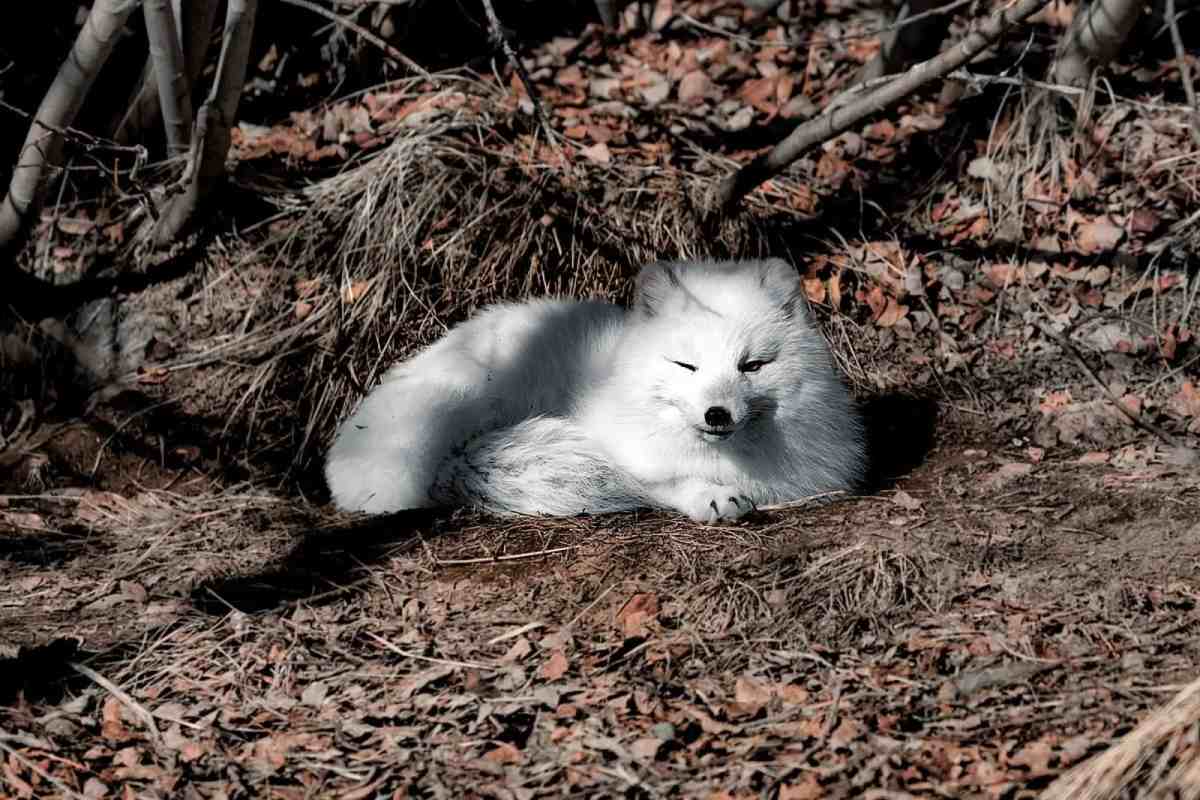
An arctic fox’s tail isn’t just for balance; it’s thick and bushy enough to work as a built-in blanket, and foxes will curl up and wrap their tails around their bodies and faces while sleeping to trap warmth and shield themselves from wind. Their fur coat is also seasonal engineering at its finest: it can be up to twice as thick in winter as in summer, with a dense undercoat trapping air for insulation beneath longer guard hairs that repel moisture and wind.
Even their eyes are adapted for the environment: a reflective layer called the tapetum lucidum improves their night vision, which is especially useful during the weeks of near-total darkness that define the Arctic winter, a trait they share with other night-active species like owls (see how long do owls live for more on nocturnal adaptations).
Cool Facts About Arctic Fox Families and Pups
Arctic foxes often live in family groups larger than a typical mated pair, with older offspring sometimes staying behind to help raise the next litter a rare cooperative breeding behaviour for wild canids. Litters are unusually large for a fox species, averaging 5 to 8 pups but capable of reaching up to 14 or more in years when food, particularly lemmings, is abundant; this makes the Arctic fox one of the most prolific breeders among wild canids relative to its size.
Pups are born blind and helpless in the den, typically in April or May, and grow quickly, becoming independent and capable of leaving to establish their own territory by early autumn a turnaround of just a few months from birth to self-sufficiency, quite different from the longer maturation period seen in animals like horses.
Arctic Fox Habitat And Range
Arctic foxes live across the circumpolar Arctic, occupying tundra, coastal areas, and even sea ice in some of the coldest, most exposed environments on Earth. Their range and the way they cope with that climate are closely linked, shaping everything from where they den to how far they roam.
Climate Adaptations
Arctic foxes are suited to habitats that swing between two extremes: brutally cold, snow-covered winters and short, cool summers where the ground briefly thaws. They favour open tundra over forested areas because it offers better visibility for spotting prey and predators, along with soil that’s workable enough for digging extensive den systems, often built into south-facing slopes or riverbanks where the ground thaws earliest in spring. In coastal regions and areas near sea ice, arctic foxes take advantage of marine food sources, and some populations spend significant time on pack ice far from land, following polar bears or hunting seal pups at breathing holes a habitat use pattern almost unique to this species among Arctic land mammals.
Countries Where Arctic Foxes Are Found
Arctic foxes have one of the widest natural distributions of any Arctic mammal, found across Northern Canada, Alaska, Greenland, Iceland, Svalbard, mainland Scandinavia (Norway, Sweden, and Finland), and Arctic Russia, including Siberia, the same region famously home to the Siberian tiger.
However, the two species occupy very different niches within it. Iceland holds particular significance as the only land mammal native to the island before human settlement, having arrived by crossing sea ice during the last ice age. Population sizes vary sharply by region: mainland Scandinavian populations have struggled for decades and remain critically endangered, with only a few hundred adults left. In contrast, circumpolar populations overall are estimated in the hundreds of thousands, illustrating how localised pressures like habitat loss and red fox competition can put a widespread species at risk in specific areas.
Arctic Fox Threats And Conservation Status
Arctic foxes face pressure from both natural predators and a warming climate that’s reshaping their habitat and food supply. Overall, the species is classified as Least Concern globally, but several regional populations tell a very different story.
Predators
Adult arctic foxes have relatively few natural predators thanks to their remote habitat. However, golden eagles, wolves, and polar bears will take them opportunistically, and larger birds of prey pose a real threat to unguarded pups. The more significant threat comes from a competitor rather than a predator: red foxes, which are larger and more dominant, have been expanding northward into arctic fox territory as the climate warms, outcompeting them for den sites and food and, in some cases, directly killing arctic fox young.
This kind of size-driven dominance among predators echoes debates elsewhere in the animal kingdom, like whether tigers are bigger than lions; size and territorial pressure often decide which species controls a habitat. This competitive pressure is considered one of the primary drivers behind the collapse of arctic fox populations in mainland Scandinavia, where numbers fell so low that only a few hundred adults remained before targeted conservation programs began.
Climate Change Impact
Climate change threatens arctic foxes on two fronts: warming temperatures are shrinking the snow-covered habitat that supports their camouflage and hunting strategy, and shifting weather patterns are destabilising the lemming population cycles their diet depends on. As red foxes push further north into previously fox-inaccessible territory, arctic foxes are being squeezed into smaller, more marginal ranges, a shift researchers have already documented across parts of Scandinavia and Russia. Conservation efforts, including supplemental feeding programs and red fox control in Sweden and Norway, have shown measurable success. One long-running Swedish program helped the mainland Scandinavian population grow from under 50 adults in the early 2000s to several hundred today, demonstrating that targeted intervention can meaningfully reverse a regional decline.
Conclusion
Arctic foxes prove that size has little to do with resilience: a 6- to 10-pound animal that shrugs off -58°F cold, changes coats with the seasons, and can migrate thousands of miles across sea ice in search of food. These arctic fox facts show a species shaped almost entirely by its environment, from heat-conserving body proportions to a diet and family structure that shift with lemming cycles and available prey.
That said, the arctic fox’s story isn’t uniformly secure. While the species remains classified as Least Concern globally, mainland Scandinavian populations dropped to just a few dozen adults before conservation programs helped rebuild numbers into the hundreds a reminder that climate change and competition from red foxes are actively reshaping where and how this species survives. Understanding these facts isn’t just trivia; it’s a window into how one of the Arctic’s most specialised mammals is adapting to a rapidly changing home.
Frequently Asked Questions(FAQs)
Are arctic foxes dangerous?
Arctic foxes are not dangerous to humans and will typically flee rather than confront people. Like any wild animal, they can carry rabies or parasites, so direct contact should always be avoided, but unprovoked attacks on humans are extremely rare.
Do arctic foxes change colour?
Yes, most arctic foxes moult twice a year, turning white in winter for snow camouflage and brown-to-gray in summer to match the thawed tundra. A smaller “blue” morph keeps a slate-grey coat year-round instead of turning white.
How big do arctic foxes get?
Arctic foxes typically weigh 6 to 10 pounds and measure 18 to 27 inches in body length, plus a bushy tail around 12 inches long. That makes them roughly the size of a large house cat, despite looking bulkier due to their thick fur.
What do arctic foxes eat?
Arctic foxes are opportunistic omnivores, relying heavily on lemmings in winter and branching out to birds, eggs, fish, and berries in summer. They’ll also scavenge carcasses, often following polar bears to feed on leftover seal kills.