
Yes, tigers are bigger than lions on average. An adult male Siberian tiger can weigh up to 660 pounds (300 kg) and stretch over 10 feet from nose to tail, making it the largest of the big cats, roughly 20 to 30 per cent larger in body weight than the average male lion. The confusion often comes down to appearances: a lion’s thick mane makes its head and shoulders look broader, while a tiger’s sleek, striped coat can make its true bulk less obvious at a glance.
But when you compare verified weight, length, and height data side by side, the tiger consistently comes out on top, with the size gap varying depending on which lion and tiger subspecies you’re comparing.
Are Tigers Bigger Than Lions?
The Short Verdict
Tigers are bigger than lions in nearly every measurable way: weight, body length, and overall size. The Siberian tiger, the largest living cat subspecies, can outweigh an African lion by 100 pounds or more, and even the smaller Bengal and Sumatran tiger subspecies tend to match or exceed lion body mass. Lions do have one visual advantage: their manes create the illusion of a larger head and upper body, which is likely why the misconception persists so widely. Strip away the mane, though, and the numbers favour the tiger almost every time. If you’re curious how other big cats measure up, our breakdown of cheetahs vs leopards covers a similarly close-looking comparison.
Key Size Stats at a Glance
The table below compares average adult male measurements across the two largest tiger subspecies and the two main lion populations, since size varies significantly depending on which subspecies you’re looking at.
| Big Cat | Average Weight | Average Body Length | Shoulder Height |
|---|---|---|---|
| Siberian (Amur) Tiger | 400–660 lbs (180–300 kg) | 10.5–11 ft (nose to tail) | 3.2–3.5 ft |
| Bengal Tiger | 400–570 lbs (180–260 kg) | 9–10 ft | 3–3.5 ft |
| African Lion | 330–500 lbs (150–225 kg) | 8.2–9.8 ft | 3.5–3.9 ft |
| Asiatic Lion | 350–420 lbs (160–190 kg) | 8.2–9.2 ft | 3.5–3.8 ft |
Notably, lions edge out tigers in shoulder height, a big reason they can look taller and more imposing when standing side by side, even though tigers carry significantly more overall body mass and length.
Tiger vs Lion Weight Comparison
When comparing raw body mass, tigers are heavier than lions across almost every subspecies matchup, with the gap ranging from modest to substantial depending on which populations you compare. Weight is the single clearest data point showing that tigers, not lions, hold the size advantage among big cats, and it’s often the first thing people check when they ask whether tigers are bigger than lions.
Average Male Tiger Weight
An average adult male tiger weighs between 400 and 660 pounds (180–300 kg), with the Siberian tiger sitting at the top of that range as the heaviest cat on Earth. Bengal tigers, the second-largest subspecies, typically weigh 400 to 570 pounds. Smaller subspecies like the Sumatran tiger weigh less, often in the 220 to 310 pound range, but even these lighter tigers are still comparable to or heavier than most lions.
Average Male Lion Weight
An average adult male African lion weighs between 330 and 500 pounds (150–225 kg), making it noticeably lighter than a Siberian or Bengal tiger of the same age and health. Asiatic lions, found primarily in India’s Gir Forest, run slightly lighter still, typically topping out around 420 pounds. Even at the high end of the lion weight range, a male lion rarely matches the bulk of a large male tiger; a Siberian tiger can outweigh an African lion by more than 150 pounds.
Female Tiger vs Female Lion Weight
The same pattern holds among females: adult female tigers typically weigh 220 to 370 pounds, while adult female lions average 265 to 395 pounds, meaning the weight gap narrows considerably at this level, and some female lions can actually outweigh smaller female tigers. This closer overlap among females is one reason size comparisons between the species can vary so much depending on which individuals are being measured.
Tiger vs Lion Length and Height
Tigers are generally longer than lions nose to tail. In comparison, lions tend to stand slightly taller at the shoulder, meaning the answer to whether tigers are bigger than lions depends on whether you’re measuring length or height. Together, these two dimensions explain why the size comparison between the two big cats isn’t as simple as it first appears.
Body Length Comparison
A large male tiger measures 9 to 11 feet from nose to tail, with the Siberian tiger reaching the upper end of that range and standing as the longest big cat in the world. African and Asiatic lions measure 8.2 to 9.8 feet on average, putting even the largest lions slightly shorter than a typical Bengal or Siberian tiger. This length advantage is one of the clearest indicators that tigers, not lions, are the larger animal overall.
Shoulder Height Comparison
Lions actually stand taller at the shoulder than most tigers, averaging 3.5 to 3.9 feet compared to a tiger’s 3 to 3.5 feet. This is largely due to the lion’s longer legs relative to its body, an adaptation suited to open savanna terrain where height helps with visibility and pursuit over flat ground. It’s a key reason lions can appear more imposing when standing upright, even though tigers carry more overall mass and length.
Tail Length Differences
Tiger tails average 2.5 to 3.3 feet long, while lion tails run slightly shorter at 2.3 to 3.5 feet, a category where the two species are much closer in size than in weight or body length. The tail contributes meaningfully to a tiger’s total nose-to-tail measurement, which is one reason tigers often edge out lions in overall length comparisons even when shoulder height favours the lion.
How Much Bigger Is a Tiger Than a Lion?
On average, a male tiger is about 20 to 30 per cent heavier than a male lion, though the exact gap shifts depending on which subspecies you’re comparing. A Siberian tiger weighing 660 pounds next to an African lion weighing 500 pounds represents roughly a 32 per cent difference in body weight, one of the clearest ways to quantify just how much are tigers bigger than lions in real numbers.
Percentage Size Difference
Comparing the heaviest tiger subspecies to the heaviest lion population shows the size gap most clearly: a male Siberian tiger at the top of its weight range (660 lbs) outweighs a male African lion at the top of its range (500 lbs) by about 32 per cent. Using average rather than maximum weights, the gap narrows to roughly 20 per cent, since a typical 500-pound tiger compares against a typical 400-pound lion. Body length tells a similar story, with tigers averaging about 10 per cent longer than lions nose to tail. The percentage gap shrinks further when comparing females, where tigers hold only a modest weight advantage over lionesses.
Visual Size Comparison
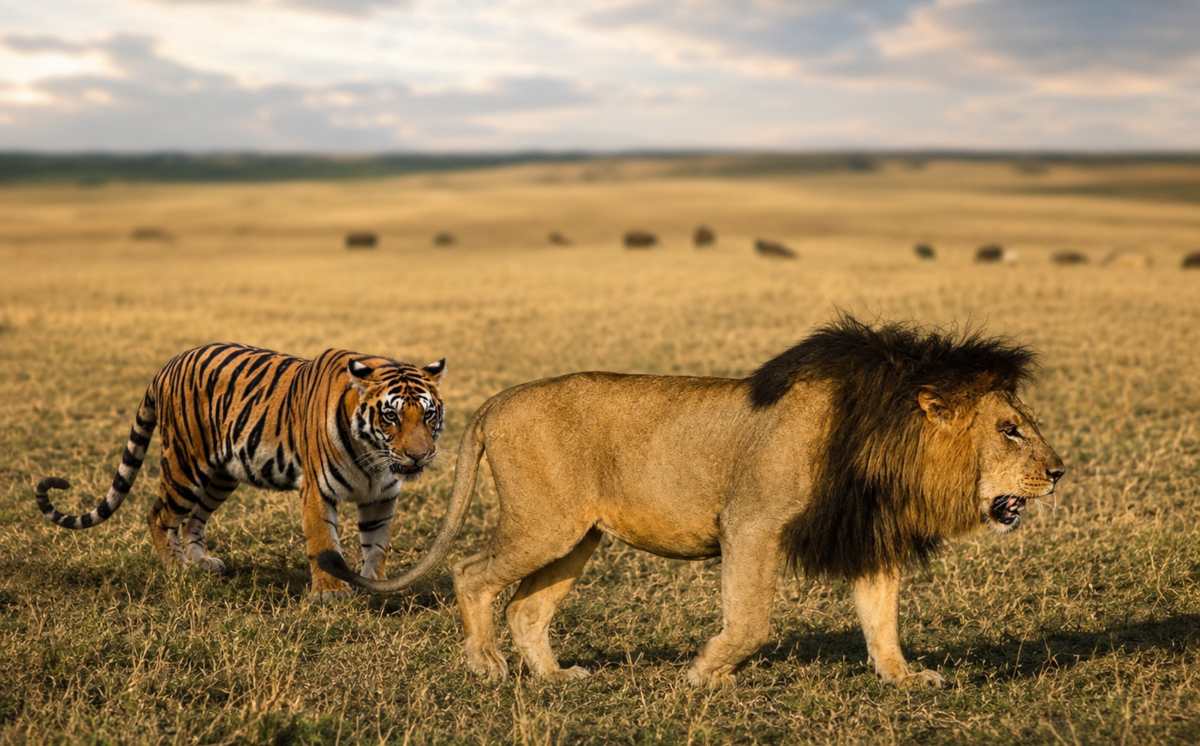
Side by side, a Siberian tiger and an African lion of average size reveal the tiger’s advantage in bulk and length, even though the lion’s mane and slightly taller shoulder height can make the two look more evenly matched than the numbers suggest. The table below breaks down the percentage difference across the key measurements.
| Measurement | Male Tiger (Avg) | Male Lion (Avg) | Tiger’s Advantage |
|---|---|---|---|
| Weight | 530 lbs | 415 lbs | ~28% heavier |
| Body Length | 10 ft | 9 ft | ~11% longer |
| Shoulder Height | 3.3 ft | 3.7 ft | Lion is ~12% taller |
This breakdown shows why the question of whether tigers are bigger than lions depends on the metric: tigers win decisively on weight and length, while lions hold a modest edge in shoulder height.
Subspecies Matter: Siberian Tigers vs African Lions
Which big cat is bigger depends heavily on which subspecies you’re comparing, since size varies significantly within both tigers and lions. A Siberian tiger dwarfs an African lion by a wide margin, but the gap narrows considerably when comparing a smaller tiger subspecies against a large male African lion.
Siberian (Amur) Tiger Size
The Siberian tiger, native to the forests of the Russian Far East, is the largest cat subspecies on the planet, with adult males weighing up to 660 pounds and measuring nearly 11 feet from nose to tail. Its size is largely an adaptation to the region’s brutal winters, where a bigger body retains heat more efficiently and supports the hunting of large prey like elk and wild boar across vast, snow-covered territory. No lion subspecies comes close to matching the Siberian tiger’s average weight, making this matchup the most lopsided in the tiger-versus-lion size debate.
Bengal Tiger Size
The Bengal tiger, found across India and parts of Bangladesh and Nepal, is the second-largest tiger subspecies, with males typically weighing 400 to 570 pounds and reaching 9 to 10 feet in length. Bengal tigers are close enough in size to African lions that individual variation can sometimes tip the scales toward a particularly large lion. However, on average the Bengal tiger still holds a clear weight advantage. This subspecies is also the most numerous tiger population in the wild, making it the most common real-world comparison point against African lions. For a deeper look at how these two tiger populations stack up against each other, see our full Siberian tiger vs Bengal tiger.
African Lion vs Asiatic Lion Size
African lions are the larger of the two living lion subspecies, with adult males averaging 330 to 500 pounds, compared to Asiatic lions, whose males typically weigh 350 to 420 pounds and are found only in India’s Gir Forest. Despite this difference between lion populations, even the largest African lion males still fall short of the average Bengal tiger and well short of the Siberian tiger, reinforcing that no lion subspecies matches the top-end size of tigers.
Beyond Size: Strength, Bite Force, and Build
Size isn’t the only factor that separates tigers and lions physically; bite force, muscle structure, and build all play a role in how each animal is adapted to hunt and survive. Tigers generally edge out lions in raw physical power as well, though the two species are built for different environments and different styles of hunting.
Bite Force Comparison
A tiger’s bite force measures around 1,050 psi, noticeably stronger than a lion’s bite force of roughly 650 psi, giving the tiger one of the most powerful bites of any big cat. This difference matters most in the field: tigers typically hunt alone and rely on a single, precise, crushing bite to the neck or throat to take down large prey like deer or wild boar, while lions often hunt cooperatively in prides, allowing them to subdue prey through combined force rather than needing one overwhelming bite.
Muscle Mass and Build Differences
Tigers carry a heavier, more muscular build overall, particularly through the front legs and shoulders, which are adapted for ambushing prey from dense cover and delivering powerful takedown strikes. Lions have a leaner, more athletic build suited to sustained pursuit across open terrain, along with slightly longer legs that support the group chases characteristic of pride hunting. These structural differences mean that even when weight is similar, a tiger’s mass tends to be more concentrated in raw power, while a lion’s build favours speed and endurance.
Does Size Alone Determine Dominance?
Size gives tigers an advantage in most head-to-head comparisons. Still, dominance in the wild depends on more than body mass alone, since lions compensate for their smaller individual size through group behaviour and cooperative hunting. In the rare historical instances where the two species have been documented interacting, largely in captivity or staged encounters, since tigers and lions don’t share overlapping habitats in the wild, the larger tiger has generally had a physical edge in one-on-one confrontations.
In their natural environments, however, neither animal’s success depends on besting the other, since each is the apex predator of its own distinct ecosystem. To see how tigers compare against other contenders for the title of nature’s most powerful animal, check out our guide to what is the strongest animal in the world.
Why the Confusion? Common Misconceptions
Despite the data clearly favouring tigers in most size measurements, many people still assume lions are the larger animal, a misconception rooted more in cultural symbolism and visual perception than in actual biology. Understanding why this belief persists helps explain the gap between widespread perception and the reality of whether tigers are bigger than lions.
Why People Think Lions Are Bigger
Lions have long held the title “king of the jungle” in Western culture, appearing more frequently in media, heraldry, and popular imagery as a symbol of power and dominance, which shapes public perception of their physical size even though tigers rarely factor into the same cultural narrative. Lions are also more commonly seen in zoos, documentaries, and pop culture throughout much of the world, giving people far more visual exposure to lions than to tigers, which are more elusive and live in less accessible regions like the forests of Siberia and India.
This imbalance in familiarity, more than any physical reality, is a major driver of the belief that lions are the bigger of the two. Big cats aren’t the only animals with reputations that outpace reality; our roundup of weird animal facts explores more surprising gaps between perception and biology.
The Role of Mane on Perceived Size
A male lion’s mane can add significant visual bulk to its head, neck, and shoulders, making the animal appear considerably larger than it actually is when standing next to a tiger. This effect is amplified in side-by-side photos or video, where the mane creates a broader silhouette that draws the eye and exaggerates the lion’s apparent frame, even though the tiger underneath its sleeker coat typically carries more actual body mass. Strip away this visual effect and compare verified weight and length data instead. The perception reverses, supporting the same conclusion the earlier size comparisons make clear: tigers are, on average, the physically larger of the two big cats.
Conclusion
Tigers are bigger than lions in the measurements that matter most: weight and body length, with the largest tiger subspecies outweighing lions by as much as 150 pounds or more. Lions do hold a slight edge in shoulder height and benefit from a visual perception boost thanks to their manes. Still, when you compare verified data across subspecies, the tiger consistently comes out as the larger, heavier, and more powerfully built of the two.
That said, the exact size gap depends heavily on which specific animals you’re comparing: a Siberian tiger towers over an Asiatic lion. In contrast, a smaller tiger subspecies and a large African lion male can be much closer in size. Rather than a simple universal answer, the true picture is one of overlapping ranges, subspecies variation, and a persistent cultural bias toward the lion’s reputation one that the numbers don’t fully support.
For anyone weighing the facts rather than the folklore, the tiger earns its place as the largest big cat on Earth. If big cat comparisons have you curious about other animal size myths and mix-ups, explore our monkey facts, the surprising difference between bison and buffalo, Arctic foxes.
Frequently Asked Questions(FAQs)
Is a tiger bigger than a lion in the wild?
Yes, in the wild, a male tiger is generally bigger than a male lion, particularly in weight and body length. This holds across most habitats, since tigers and lions don’t naturally coexist in overlapping territories.
How much bigger are tigers than lions on average?
On average, male tigers are about 20 to 30 per cent heavier than male lions, depending on the subspecies compared. Body length follows a similar pattern, with tigers typically measuring 10 per cent longer nose to tail.
Are female lions bigger than female tigers?
Not usually, though the gap narrows significantly compared to males, with some lionesses outweighing smaller female tigers. Average female tigers still hold a modest weight advantage over average female lions.
Which subspecies is the largest big cat overall?
The Siberian (Amur) tiger is the largest big cat subspecies in the world, with males reaching up to 660 pounds. No lion subspecies comes close to matching its average size or weight.









)
&description=&image=https://litefacts.com/jihujem/2026/03/Are-Tigers-Bigger-Than-Lions-1024x682.jpg)