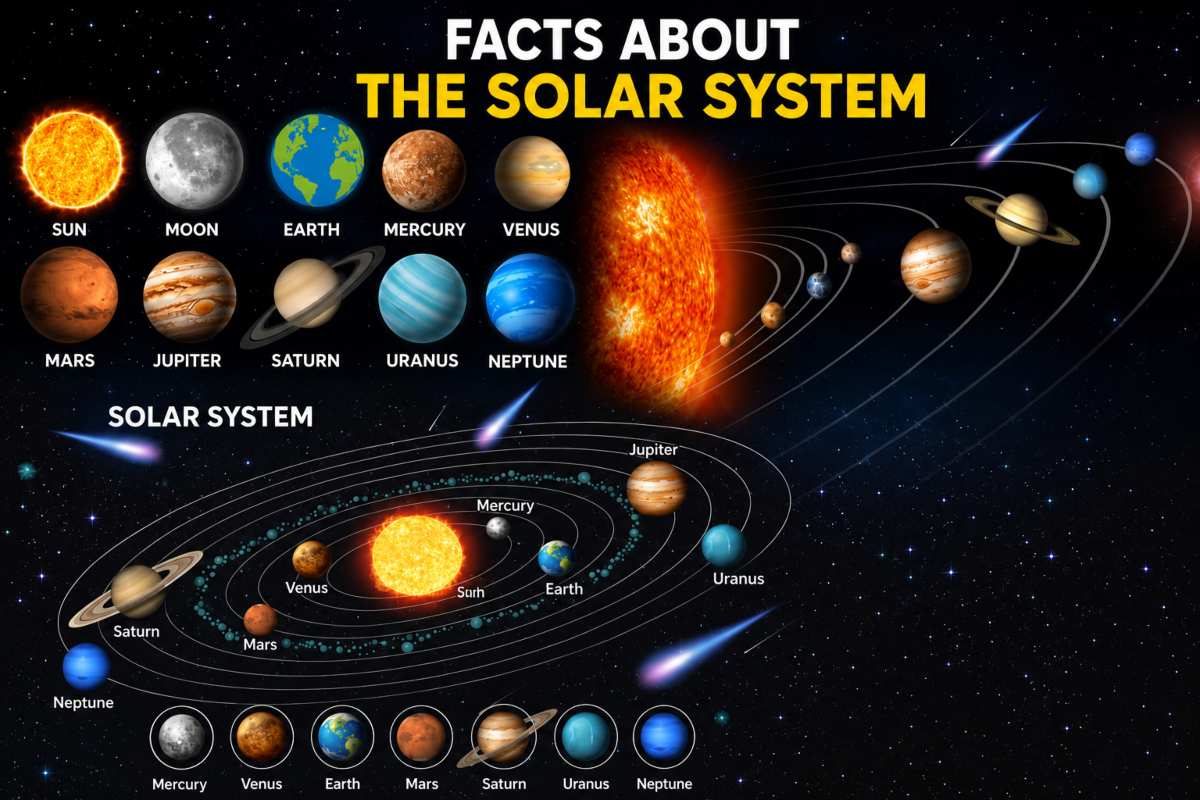
The solar system is the vast celestial neighborhood formed roughly 4.6 billion years ago when a cloud of gas and dust crumpled under its own gravity, eventually giving rise to the Sun, eight planets, over 200 moons, and countless asteroids and comets. These facts about the solar system reveal just how strange and extreme our corner of space really is, from a planet with 146 confirmed moons to a storm on Jupiter that has raged for over 350 years.
While most people learn the basics in school the Sun at the center, eight planets orbiting it, Earth as the only known home to life the details get far stranger the closer you look. Venus spins backward compared to most planets. A day on Mercury lasts longer than its entire year. And the Sun alone accounts for 99.8% of all the mass in the solar system, making every planet, moon, and asteroid combined little more than a rounding error by comparison. For more surprising discoveries across other scientific fields, check out these facts related to science.
What Is the Solar System? (Quick Overview)
The solar system is the Sun and everything bound to it by gravity: eight planets, at least 200 moons, five recognized dwarf planets, and millions of asteroids and comets, all orbiting within a region that stretches roughly 9 billion miles across. It formed from a spinning cloud of gas and dust, with nearly all of that material eventually collapsing into the Sun itself.
How Old Is the Solar System?
The solar system is about 4.6 billion years old, based on the radiometric dating of meteorites, some of the oldest unaltered material left over from its formation. Scientists determined this age by studying calcium-aluminum-rich inclusions found in certain meteorites, which crystallized before any of the planets existed. For comparison, Earth itself is slightly younger, at roughly 4.54 billion years, since it took additional time for rocky material to accumulate into a full planet.
What is at the Center of the Solar System?
The Sun sits at the center of the solar system, and its gravity is what holds every planet, moon, and asteroid in orbit. It’s a massive ball of hydrogen and helium undergoing constant nuclear fusion, and it accounts for about 99.8% of the total mass in the entire solar system, meaning all eight planets combined make up less than a quarter of a percent of everything orbiting it. Every other object, from Jupiter down to the smallest asteroid, is essentially leftover material that never got pulled into the Sun during formation.
How Many Planets Are in the Solar System?
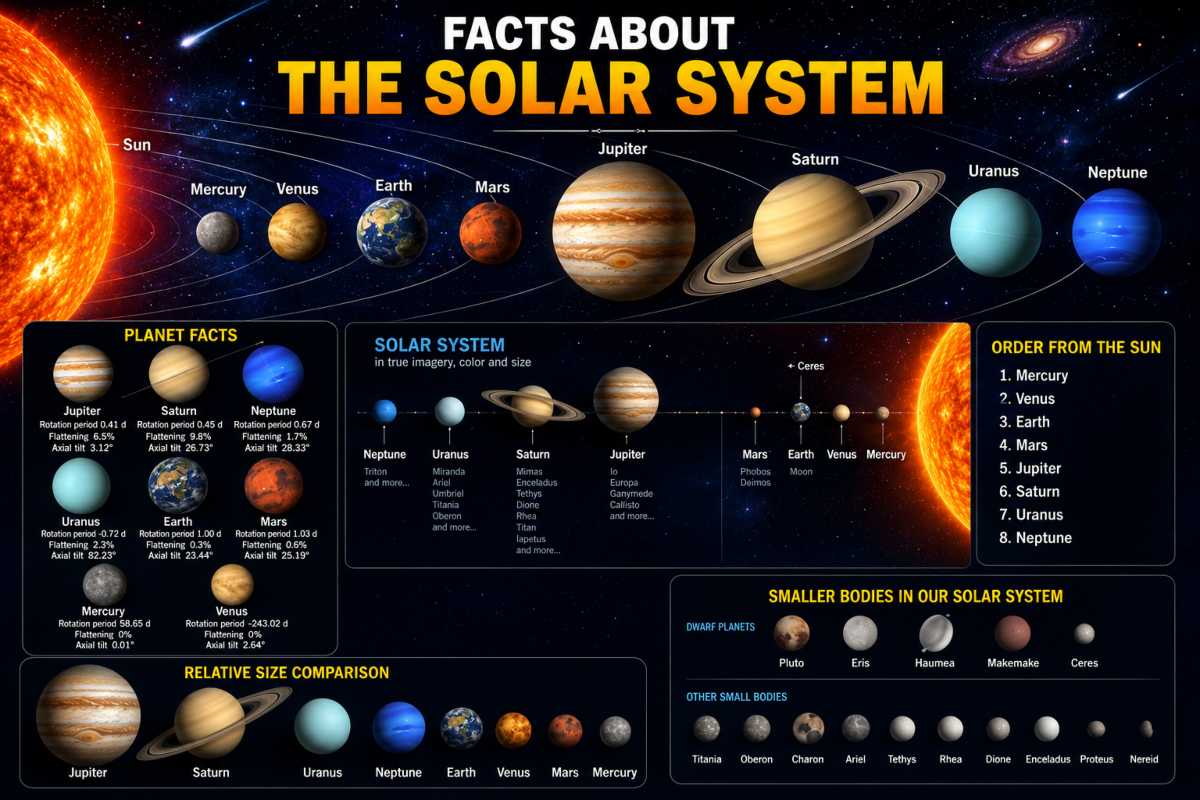
There are eight planets in the solar system: Mercury, Venus, Earth, Mars, Jupiter, Saturn, Uranus, and Neptune. They’re typically divided into two groups: the four inner “terrestrial” planets, which are small and rocky, and the four outer “gas giants” and “ice giants,” which are much larger and made mostly of gas or ice. Pluto was thought to be the ninth planet until 2006, when the International Astronomical Union reclassified it as a dwarf planet due to a stricter definition of what qualifies as a full planet.
Facts About Each Planet in the Solar System
Each of the eight planets in the solar system has a distinct personality shaped by its size, distance from the Sun, and composition, from scorched, airless Mercury to the frozen, wind-battered surface of Neptune. Here’s what makes each one stand out.
Mercury Facts
Mercury is the tiniest planet in the solar system and the closest to the Sun, yet it’s not the hottest; that title belongs to Venus, thanks to its thick atmosphere trapping heat. Mercury has virtually no atmosphere to hold in warmth, so temperatures swing wildly between about 800°F during the day and -290°F at night. Strangely, a single day on Mercury (one full rotation relative to the Sun) lasts about 176 Earth days, while its year one full orbit around the Sun carries only 88 Earth days, meaning a Mercury day is longer than its year.
Venus Facts
Venus is the most alluring planet in the solar system, with surface temperatures averaging around 900°F, hot enough to melt lead, caused by a runaway greenhouse effect from its dense carbon dioxide atmosphere. It’s also the only planet that rotates clockwise (retrograde) relative to its orbit, meaning the Sun rises in the west and sets in the east on Venus. A single day on Venus takes 243 Earth days to complete, longer than its 225-day year, making it the slowest-spinning planet in the solar system.
Earth Facts
Earth is the only known planet in the solar system to support life, largely due to its distance from the Sun, liquid water, and protective atmosphere. It’s also the densest planet in the solar system, a result of its rocky composition and iron-rich core. Earth’s single natural satellite, the Moon, is unusually large relative to its planet, about 27% of Earth’s diameter, which is why it exerts enough gravitational pull to cause ocean tides. For a deeper look at what makes our own planet so unique, explore these interesting Earth facts. Earth’s tilted axis and yearly orbit around the Sun are also the reason behind the changing seasons, a cycle explored in detail in the Wheel of the Year.
Mars Facts
Mars, often called the Red Planet due to iron oxide (rust) covering its surface, is home to Olympus Mons, the greatest volcano in the solar system at roughly 13.6 miles high, nearly three times the height of Mount Everest. Mars has two small, irregularly shaped moons, Phobos and Deimos, which scientists believe are captured asteroids rather than moons formed alongside the planet. A day on Mars is remarkably close to Earth’s, lasting about 24 hours and 37 minutes, but its year stretches to 687 Earth days.
Jupiter Facts
Jupiter is the largest planet in the solar system, with a mass more than twice that of all the other planets combined, and its Great Red Spot is a storm that has been steaming for at least 350 years. Jupiter also has the most confirmed moons of any planet, with 95 officially recognized, including Ganymede, the largest moon in the solar system, bigger even than the planet Mercury. Despite its massive size, Jupiter spins faster than any other planet, completing a full rotation in just under 10 hours. To put its scale into perspective, see exactly how many Earths can fit in Jupiter.
Saturn Facts
Saturn is best known for its dramatic ring system, made up of billions of ice and rock particles ranging from tiny grains to chunks the size of mountains. It’s the least dense planet in the solar system, so low in density that it would theoretically float in water if there were an ocean large enough to hold it. Saturn also has 146 confirmed moons, the most of any planet as of current counts, including Titan, which has a thick atmosphere and liquid methane lakes on its surface.
Uranus Facts
Uranus is unique for rotating almost completely on its side, with an axial tilt of about 98 degrees, likely the result of a massive collision early in its history. This sideways spin means its poles experience roughly 42 years of constant sunlight followed by 42 years of darkness during each orbit. Uranus is classified as an “ice giant” rather than a gas giant, since it’s composed largely of water, ammonia, and methane ices surrounding a small rocky core.
Neptune Facts
Neptune is the farthest known planet from the Sun and has the quickest winds in the solar system, with gusts recorded at over 1,200 miles per hour. It takes Neptune about 165 Earth years to complete a single orbit, meaning it has only finished one full orbit since its discovery in 1846. Neptune’s largest moon, Triton, is unusual because it orbits in the opposing direction of the planet’s rotation, indicating it was likely a captured object rather than a moon that formed alongside Neptune.
Fun And Surprising Facts About the Solar System
Beyond the basic planetary data, the solar system is full of details that sound almost too strange to be true: planets that smell like rotten eggs, storms bigger than entire worlds, and moons more likely to host life than the planets they orbit. These fun facts about the solar system show just how much stranger space gets the closer you look.
Mind-Blowing Space Facts
One of the most mind-blowing facts about the solar system is that a single teaspoon of material from a neutron star, while not technically part of our solar system, would weigh about 10 million tons, illustrating just how extreme density can get in the universe our solar system belongs to.
Closer to home, the Sun is so large that roughly 1.3 million Earths could fit inside it, and light from the Sun takes about 8 minutes to reach Earth, meaning we always see the Sun as it looked 8 minutes in the past. Saturn’s rings, despite spanning up to 175,000 miles across, are in some places only about 30 feet thick, proportionally thinner than a sheet of paper relative to their width.
Weird Facts You Didn’t Know
Uranus has an atmosphere that contains hydrogen sulfide, the same compound accountable for the smell of rotten eggs, making it one of the only planets with a documented (if unpleasant) odor. Venus, meanwhile, has such crushing atmospheric pressure that it would instantly crush an unprotected human, and its clouds are made of sulfuric acid rather than water vapor. Perhaps strangest of all, a day on Venus is longer than a year on Venus, since the planet rotates so slowly that it completes an orbit around the Sun before finishing a single full spin on its axis.
Record-Breaking Facts (Biggest, Smallest, Hottest, Coldest)
Jupiter holds the record as the biggest planet in the solar system, with a diameter of about 86,881 miles, more than 11 times wider than Earth. Mercury is the smallest official planet since Pluto’s reclassification in 2006, at just 3,032 miles in diameter, smaller than some moons in the solar system, including Ganymede and Titan. Venus remains the hottest planet at an average surface temperature of 900°F, despite Mercury being closer to the Sun. At the same time, Uranus holds the record for the coldest planetary atmosphere, with temperatures dropping to -371°F, colder than Neptune despite being nearer to the Sun.
Solar System Facts for Kids (Simple Explanations)
These solar system facts for kids break down the basics in simple, easy-to-follow language, perfect for young learners, classroom lessons, or curious kids who want to know how our solar system works. No confusing science terms, just the fun stuff explained clearly.
Easy Solar System Facts for Classroom Learning
The solar system has one Sun, eight planets, and lots of moons, all held together by gravity. The Sun is a giant, bright ball of hot gas, and it’s so big that more than a million Earths could fit inside it. The planets closest to the Sun Mercury, Venus, Earth, and Mars are made of rock, while the planets farther away Jupiter, Saturn, Uranus, and Neptune are made mainly of gas and ice. It takes Earth 365 days to travel all the way around the Sun, which is why a year is 365 days long.
Fun Solar System Trivia for Kids
Did you know that a day on Venus is longer than a whole year on Venus? That’s because Venus spins around very, very slowly so gradually that it takes 243 Earth days just to turn all the way around once, but only 225 Earth days to go all the way around the Sun. Here are a few more fun facts kids love:
- Jupiter is so big that all the other planets could fit inside it at the same time.
- Saturn’s rings are made of ice and rock, and some pieces are as small as a grain of sand while others are as big as a house.
- Mars is called the “Red Planet” because it’s covered in reddish dust that looks like rust.
- The Moon doesn’t make its own light; it just reflects light from the Sun.
Solar System Facts Worksheet Ideas
Teachers and parents can turn these facts into simple, hands-on worksheet activities that help kids remember what they’ve learned. A great starting point is a “match the planet to the fact” worksheet, where kids draw lines connecting each planet to one fun fact about it, like matching Saturn to its rings or Mars to its red color.
Another effective idea is a fill-in-the-blank worksheet using sentences like “The is the biggest planet in the solar system” (Jupiter) or “It takes Earth days to go around the Sun” (365), which reinforces both vocabulary and basic facts at the same time. For younger kids, a simple coloring worksheet of the eight planets in order from the Sun works well alongside a short fact written under each one.
Moons, Asteroids And Dwarf Planets
Beyond the eight planets, the solar system is packed with hundreds of moons, five recognized dwarf planets, and a belt of rocky debris left over from its formation, each playing a distinct role in the overall structure of our cosmic neighborhood. Here’s a closer look at these often-overlooked objects.
Fun Facts About Moons in the Solar System
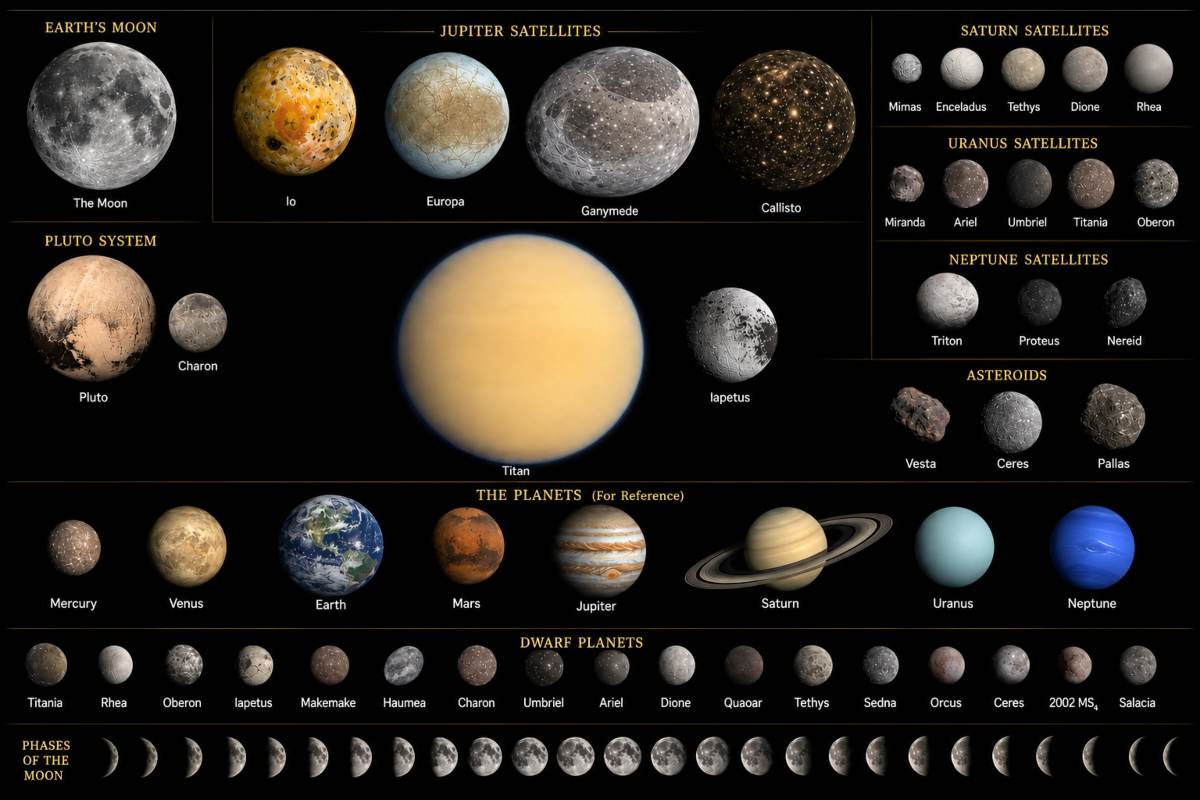
There are more than 300 confirmed moons in the solar system, and they range dramatically in size, composition, and behavior. Saturn currently holds the record with 146 confirmed moons, followed closely by Jupiter with 95, while Mercury and Venus have none at all. Some moons are stranger than the planets they orbit. Jupiter’s moon Europa is believed to hide a liquid water ocean beneath its icy crust, making it one of the most promising places in the solar system to search for life, and Saturn’s moon Titan has lakes and rivers made of liquid methane rather than water.
What Are Dwarf Planets? (Pluto & Others)
A dwarf planet is an entity that orbits the Sun and is round due to its own gravity, but hasn’t cleared its orbital path of other debris the way a full planet has. This distinction cost Pluto its planetary status in 2006. Pluto remains the most famous dwarf planet, but it’s not alone: Eris, Haumea, Makemake, and Ceres are also officially classified as dwarf planets, with Ceres being unique in that it’s located in the asteroid belt rather than the outer solar system. Pluto itself has five known moons, the largest of which, Charon, is so big relative to Pluto that the two are sometimes described as a “double dwarf planet” system.
Asteroid Belt Facts
The asteroid belt is a region located between Mars and Jupiter that contains millions of rocky objects ranging from tiny pebbles to Ceres, which, at about 590 miles in diameter, accounts for roughly a third of the belt’s total mass. Despite how it’s often depicted in movies, the asteroid belt is mostly space; the average distance between asteroids is so vast that spacecraft have passed through it multiple times without a single collision. Scientists believe the asteroids never formed into a planet because Jupiter’s powerful gravity constantly disrupted their ability to clump together, leaving them scattered as debris instead.
How the Solar System Compares (Size And Distance)
The planets in the solar system vary enormously in both size and distance from the Sun, with Jupiter alone being more than 1,300 times the volume of Earth, and Neptune orbiting roughly 30 times farther from the Sun than our own planet does. Understanding these differences in scale helps explain why the inner and outer solar system behave so differently.
Distance Between Planets (Visual Comparison)
Distances in the solar system are typically measured in astronomical units (AU), where 1 AU equals the distance from Earth to the Sun, about 93 million miles. Mercury sits closest at just 0.39 AU from the Sun, while Neptune, the farthest official planet, orbits at about 30 AU away, meaning sunlight that reaches Earth in 8 minutes takes over 4 hours to reach Neptune. The gap between planets also grows dramatically the farther out you go: the distance between Jupiter and Saturn alone is roughly four times greater than the entire distance from the Sun to Earth, which is part of why outer planets take so much longer to complete a single orbit.
Planet Size Comparison Chart
Size differences across the solar system are just as dramatic as the distances. Jupiter is by far the largest planet, while Mercury is the smallest since Pluto’s reclassification as a dwarf planet in 2006.
| Planet | Diameter (miles) | Compared to Earth |
|---|---|---|
| Mercury | 3,032 | 0.38× |
| Venus | 7,521 | 0.95× |
| Earth | 7,918 | 1× |
| Mars | 4,212 | 0.53× |
| Jupiter | 86,881 | 11.2× |
| Saturn | 72,367 | 9.1× |
| Uranus | 31,518 | 4× |
| Neptune | 30,599 | 3.9× |
This size gap is so extreme that Jupiter’s diameter alone is roughly 28 times larger than Mercury’s, and Earth could fit inside Jupiter more than 1,300 times over based on volume rather than diameter alone.
Final Thoughts
The solar system is far more dynamic and extreme than most people realize, a single Sun holding together eight planets, hundreds of moons, and millions of asteroids across a span of roughly 9 billion miles, all shaped by the same gravitational forces that formed it 4.6 billion years ago. From Venus’s crushing, sulfuric atmosphere to Jupiter’s centuries-old storm to the icy, sideways spin of Uranus, these facts about the solar system show that even the most familiar cosmic neighborhood still holds plenty of surprises.
What makes the solar system worth studying isn’t just its scale, but how different each part truly is; no two planets share the same conditions. Even neighboring worlds like Earth and Venus, similar in size, ended up on opposite ends of habitability. As space missions continue to explore moons like Europa and Titan, both considered strong candidates for hosting some form of life, our understanding of the solar system is likely to keep shifting in ways that make even these facts subject to updates in the years ahead.
Frequently Asked Questions(FAQs)
How many planets are in the solar system?
There are eight planets in the solar system: Mercury, Venus, Earth, Mars, Jupiter, Saturn, Uranus, and Neptune. Pluto was once considered the ninth planet but was reclassified as a dwarf planet in 2006 after the International Astronomical Union introduced a stricter definition of what qualifies as a full planet.
What is the largest planet?
Jupiter is the largest planet in the solar system, with a diameter of about 86,881 miles, more than 11 times wider than Earth. Its mass is greater than all the other planets combined, making it by far the dominant planetary body after the Sun.
Is Pluto still a planet?
No, Pluto is no longer classified as a planet. Since 2006, it has been officially categorized as a dwarf planet because it hasn’t cleared its orbital path of other debris, which is one of the three criteria required for full planet status.
How was the solar system formed?
The solar system formed about 4.6 billion years ago from a massive cloud of gas and dust that collapsed under its own gravity. Most of that material condensed into the Sun, while the leftover debris gradually clumped together to form the planets, moons, and asteroids.

)
&description=&image=https://litefacts.com/jihujem/2026/07/Facts-About-the-Solar-System-1024x683.jpg)